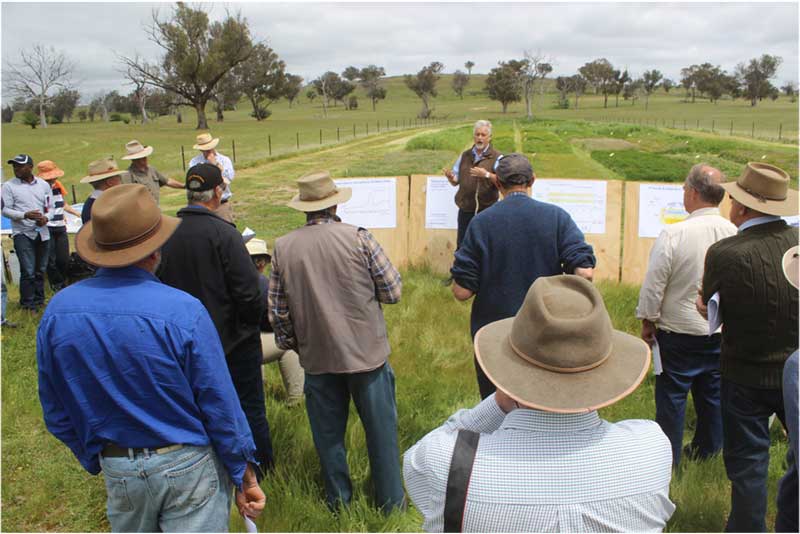
 Richard Simpson discusses pasture responses to P fertiliser.
Are your phosphorus decisions delivering profit?
Are you getting the best value out of your fertiliser? Producers can take the guesswork out of soil testing and fertiliser decision making on pastures with a five-step phosphorus (P) tool.
Pasture productivity is strongly linked to soil P management. A common challenge for producers is optimising money spent on fertiliser with improved production and profitability.
Soil fertility research and development in Australia since the 1950s has provided the key steps needed to address this challenge.
Australian research supports sound decisions
After soil testing methods were developed, reliable and affordable soil testing services soon followed. Several decades of field trials explored how pasture growth responded to soil test levels for P, sulfur (S) and potassium (K) across southern Australia.
A major review of results from over 650 experiments in the ‘Better Fertiliser Decisions for Pastures’ project led to universally-applicable critical soil test P, S and K levels.
“Critical” soil test levels indicate when pasture growth will be at about 95% of maximum potential.
"This was a watershed moment for soil fertility management under pastures," said Richard Simpson, a member of the team from CSIRO and NSW DPI that developed the Five Easy Steps P Tool.
"It underpins the sequence of simple, evidence-based steps that producers can now follow to ensure they’re getting better production and value from fertiliser use."
The value of soil testing
Being able to accurately identify nutrient deficiencies and calculate corrective fertiliser rates was transformative for producers, according to Richard.
When the tool was pulled together in 2009, P prices had skyrocketed by 600%.
"Starting with soil testing, producers can now forward estimate how much their production will be increased by better soil fertility management," Richard said.
"It can lead to a more cost-effective use of fertiliser.”
From research to a practical decision-support tool
MLA incorporated the Five Easy Steps into an interactive online ‘P Tool’, which is free to access. It guides producers through the five steps of how to:
1. Assess P-fertility status through soil testing
2. Match stocking rates to soil fertility goals
3. Calculate the optimal P fertiliser rates
4. Assess other possible constraints
5. Analyse the profitability of proposed P investment.
The MLA P tool emphasises soil P management because P is almost universally the most deficient nutrient in Australian soils.
However, Richard said the Five Steps requires producers to think about whether other nutrients or soil conditions could also constrain production and to achieve balanced soil fertility management.
Unlocking the P Tool’s potential
For landholders using the Five Easy Steps for the first time, the process can sometimes seem daunting, Richard said.
Support is available through workshops rolled out by NSW Local Land Services (LLS) which steps producers through the framework. Participants are also taught how to use MLA's P Tool.
“It’s much easier to attend one than reading a booklet on your own,” Richard said.
“I have observed several LLS workshops and I don’t think I’ve ever seen anyone walk out without changing the way they think about soil fertility management.”
To achieve long-term success with Five Easy Steps, Richard suggests producers get into a habit of annually monitoring soil fertility and plotting the data.
“Combining objective fertiliser decisions with ongoing monitoring practices gives producers real power to boost productivity on their farms,” Richard said.