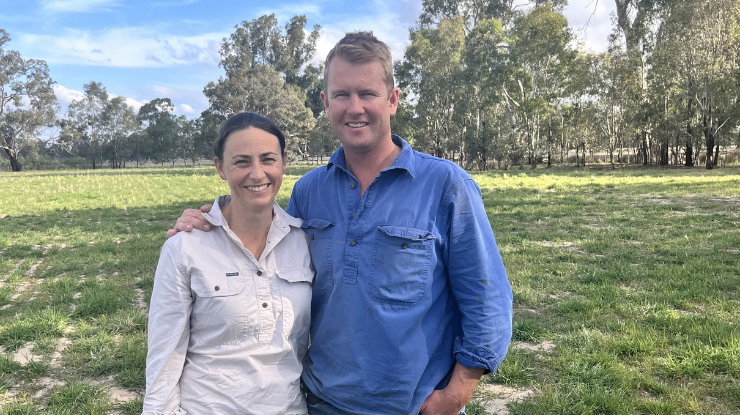
 Georgia and Will Johanson
Early measurement drives stronger triplet survival
Rather than seeing triplets as simply a by-product of higher production, Victorian producer Will Johanson views them as a distinct management challenge and opportunity.
Will and his wife Georgia run a prime lamb enterprise near Euroa in north-east Victoria, managing about 4,300 composite ewes across a mix of owned and leased country.
They are involved in MLA’s ‘Improving survival of triplet dams and their lambs’ Producer Demonstration Site (PDS).
A key message from the PDS is that improving outcomes for triplets starts with measurement, and Will is already well placed to see that firsthand.
“We treat them as a higher-need class of stock from the day they’re identified,” he said
Measuring what matters
As well as running his own flock, Will operates a contract pregnancy scanning business. This gives him a valuable insight into how widely triplets are identified across the industry.
“Less than 10% of the sheep I scan would be scanned for triplets,” he said.
That lack of visibility can mask the true scale of losses.
“You don’t know what your survival is unless you’re scanning for them,” he said.
“A lot of the losses are essentially invisible if you’re not separating them out.”
For Will, the PDS has reinforced a simple principle: if you don’t measure it, you can’t improve it.
Managing high-risk ewes
Once identified, triplet-bearing ewes in the Johansons’ flock are managed differently from the rest of their ewes. They are prioritised for feed, handled first during key husbandry operations and allocated the best available paddocks.
“They’re the highest-risk cohort on the farm,” Will said.
Maintaining ewe condition through pregnancy is a key focus, reflecting the project’s emphasis on nutrition as a driver of survival.
At lambing, mob size becomes critical. In favourable seasons, Will aims to lamb triplets in smaller mobs, ideally around 25 ewes, to improve ewe–lamb bonding and reduce mismothering.
To achieve this, the Johansons use temporary electric fencing to subdivide paddocks and create smaller lambing mobs within their existing infrastructure.
“Reducing mob size and using paddocks with more shelter and privacy makes a big difference,” Will said.
Seasonal conditions can limit what’s achievable, but the principle remains: more targeted management leads to better outcomes.
From scanning to survival
The Johansons’ system closely reflects the core aim of the PDS, to shift focus from scanning results alone to the number of ewes and lambs that survive to marking.
On their property, twin lamb survival averages around 85%, while triplet survival has reached up to 70% in favourable seasons. Ewe mortality is also higher in triplet-bearing ewes, highlighting the importance of targeted management.
For Will, involvement in the project has reinforced that success with triplets comes down to detail.
By identifying triplets early and managing them accordingly, he sees ongoing opportunity to improve both productivity and welfare outcomes, turning a challenging cohort into a more reliable contributor to the business.
He also has his sights set on continually refining how triplet-bearing ewes are managed, particularly through further reductions in mob size and maintaining ewe condition through pregnancy.
“Scanning is the starting point,” he said.
“It allows you to allocate your feed, labour and best paddocks to the animals that need it most.”
By focusing attention on this higher-risk cohort, producers can improve both survival and overall flock performance, ensuring triplets contribute positively to the bottom line rather than becoming a hidden source of loss.