Turning data into dollars
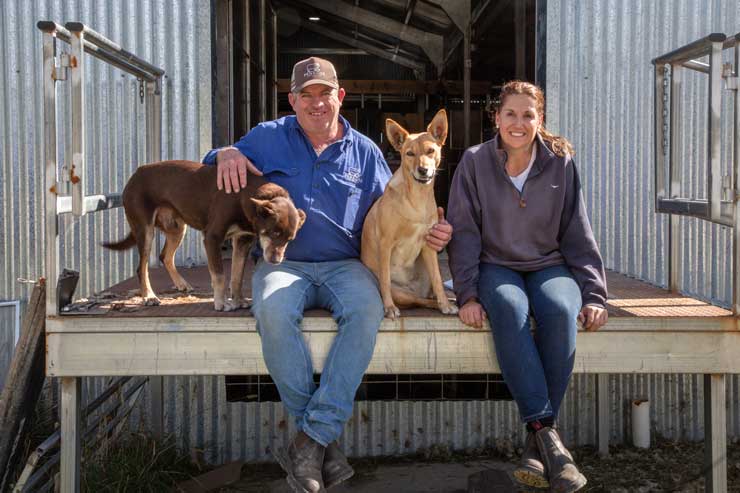
Fifth generation producers Jack and Jen Medway, along with their three children, run a dual-purpose sheep enterprise at ‘Hillcrest’ in the NSW Southern Tablelands.
They opened their gate to participants at an MLA MeatUp Forum in Cooma earlier this year, for a virtual farm tour.
Here’s a look at how they’ve invested in electronic identification (eID) tags to fast track their transition from superfine wool growers to include a meat focus, and how they are harnessing data to hit production targets.
Farm snapshot
-
NameJack and Jen Medway, ‘Hillcrest’
-
LocationGunning, NSW
-
Area1,821ha
-
Enterprise10,000 sheep, lambing 70% Merino, 30% crossbred Border Leicester
-
PasturesNative and improved pastures, mix of sub-clover, phalaris and ryegrass
-
SoilsGranite and basalt
-
Rainfall550–650mm
Ag-tech powers productivity
The tight-knit team run their operation largely by themselves, with Jen focusing on the data analysis and business side of things, while Jack manages the livestock operation. They are supported by a small group of valued contractors.
Early adoption of data collection and ag-tech has helped the couple optimise their business and farming efficiencies, and reduced their labour requirements.
Best of all, their data-backed approach has given them the confidence and ability to make astute and timely decisions in the hard times.
Around 1,500–2,000 of the couple’s crossbred (Merino x Border Leicester) lambs are turned off at the three-month mark most years, while on the Merino side, they sell off most of their wethers around five years old at about 1,000 per year. The older ewes go off into their cross-bred operation.
“We cull wethers according to visual assessment and age but would like to start collecting data using their eIDs in the October/November shearing window,” Jen said.
Ewes are culled using a data-informed approach after an initial visual cull, which takes out about 8% of their hogget.
“We get an indexing through Ram Power and then use the data to skim off the bottom producing ewes up to whatever number we need for that year.
“The lowest performers go through to the crossbred operation, as the genetics are not passed on, given we put them over a Border Leicester ram.
“With the remaining ewes, we then pick specific traits (e.g. micron, wool cut etc.), separate into mobs and use ram genetics to cross them, for example putting heavy cutting rams with lighter cutting sheep etc.
“The gist of our plan is to lift the overall productivity of our mob, taking out the bottom performers and improving those animals we retain on the property,” Jen said.
“We also have a stud program for our top performers, to keep the tops powering ahead, which we have done using the data captured over the past nine years.”
Achieving productivity targets
This approach, linked with eID data generated across the farm, gives the couple the confidence that the flock they have retained will help them achieve their overall productivity targets year on year.
Depending on prices, around 60% of their income comes from wool, with Jack’s targets set at each sheep providing around 5.5kg of wool at 17 micron.
He uses three key breeding values to achieve his breeding objectives:
- wool cut
- fertility
- body weight.
Jack targets a mature liveweight of around 60–65kg liveweight, for optimal feed efficiency.
The Medways only containment feed when necessary, such as during drought or dry times, although this may be an area for development in the future. They supplementary feed fairly regularly and provide mineral blocks to ensure optimal nutrition.
Soil and animal testing has shown sheep to be prone to deficiencies at certain times of the year so this approach helps to proactively address deficiencies.
eID tags a game changer
Almost a decade after implementing electronic identification (eID) tags to fast track their transition from superfine wool growers to a dual-purpose sheep enterprise – Jen’s efforts in data collection and analysis have paid off.
A key shift in their approach has been the move from a mob-based to a more individual style of management.
“We started out making the mistake of trying to capture everything, which was expensive and a complete waste of our time and money,” she said.
“We weren’t using the data that we were actually getting – we sat down and acknowledged we weren’t getting where we needed to.”
By narrowing their focus to wool testing, they were able to accurately determine their micron and fleece weight, while on the other side they concentrated on body weight and fertility.
Recording data on pregnancy status (singles, multiples or dry) using scanning data has also made a big difference.
Once they had a clearer idea of what they were trying to measure and why, as well as investing in technology by Breed Elite, things really fell into place. The technology’s interoperability was key to maximising the insights they now had access to.
“We use the data to index our hoggets each year through Ram Power, which gives us a list of our most productive animals from one to 2,000,” Jen said.
“While the data helps to manage our genetics, in a drought, it also allows us to know which animals to cull and which to retain.”
Being a wool-focused business, fleece weight is their number one priority, while on the meat side, body weight is key. Their return on investment became apparent early on, with the couple achieving half a kilo increase of wool year-on-year. Having the data enables them to leverage and track the gains they are making.
Challenges
Finding the right people to help them in the early stages of data implementation was a significant challenge.
Cost was another obstacle, although with their healthy return on investment and the increased confidence about which animals to cull during droughts for example, investing in ag-tech was a no brainer.
“It means we’re not feeding sheep that aren’t going to pay us back,” Jack said.
Register now to attend the MeatUp Forum in Broken Hill, NSW, on 14 October.