Early sowing pays off at Gippsland demo
In 2025, a new on-farm demonstration in Gippsland set out to answer a question every livestock producer faces: when is the right time to sow new pastures?
As part of a Producer Demonstration Site (PDS) project funded by Meat & Livestock Australia and delivered by Agriculture Victoria, the Gippsland Agricultural Group’s demonstration farm became a testing ground to help inform smarter decision-making. By tracking soil moisture and temperature in real time, the project showcases how better data can guide timing of sowing, ultimately improving pasture establishment and productivity.
Context
The East Gippsland region is characterised by variable seasonal conditions – particularly around the timing of the autumn break (the first substantial rainfall event), which is often unpredictable and unreliable.
Typically, producers in this region sow pastures based on calendar dates, rather than making decisions based on soil temperature and soil moisture levels.
In the lead up to the autumn break, paddocks are often sprayed in preparation for resowing to reduce weed burden and moisture competition. Decisions on when to sow are often based on a quick visual assessment of soil conditions combined with the rainfall outlook.
This trial explored how different sowing times, guided by soil moisture and temperature data, influence pasture establishment, growth rates and overall productivity in the critical early months after sowing.
The site
The paddock selected for the demonstration at the GAgG research site was nearing the end of its productive life and required renovation. It had previously been used for fodder crops before being sown down to an annual ryegrass pasture that had been allowed to self-seed.
The paddock consisted of a sandy loam topsoil over a medium to heavy clay subsoil.
A soil test was conducted prior to sowing (Table 1).
Table 1: Soil test results prior to sowing
|
Soil property |
Result |
|
Available Potassium |
150mg/kg |
|
pH (CaCl2) |
5.2 |
|
Olsen Phosphorus |
16mg/kg |
|
Sulphur (KCl 40) |
9.3mg/kg |
|
PBI |
66 |
The pasture mix used (supplied by DLF seeds) was based on a high rainfall mix being trialled through Agriculture Victoria’s ‘Pasture 365’ project and comprised:
- Base Perennial Ryegrass AR37 at 12.5kg/ha
- Aurus Cocksfoot at 5kg/ha
- Hilltop White Clover at 1.5kg/ha
- Amigain Red Clover at 1.5kg/ha
- Palestine Strawberry Clover at 1.5kg/ha
- Ecotain Plantain at 1.5kg/ha
- Puna II Chicory at 1.5kg/ha.
Four sowing times were selected to cover different combinations of soil temperature and soil moisture conditions. The paddock was sprayed out and areas left fallow until their time of sowing. This was to simulate conditions where a producer may have sprayed their paddock in readiness for renovation, but the autumn break was then late or lacking.
The paddock was divided into four different sections, one for each time of sowing. The four sowing windows in this demonstration were: early to mid-autumn, late autumn, mid-winter and early spring. At each sowing, 100kg/ha of DAP and 30kg/ha of SOP was applied.
Results
Dry conditions throughout most of the demonstration impacted overall production at each sowing time. Rainfall was below average in April, May, July, September and October (Figure 1). The impact was especially evident in August and September, with sharply declining soil moisture during the critical period for spring growth.
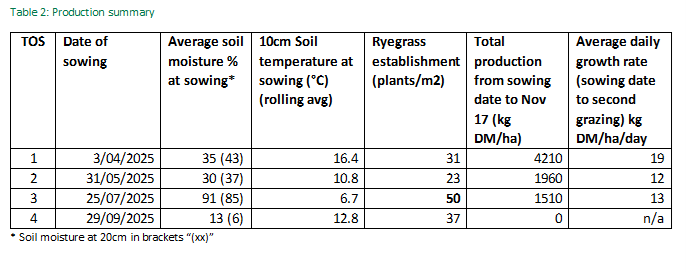
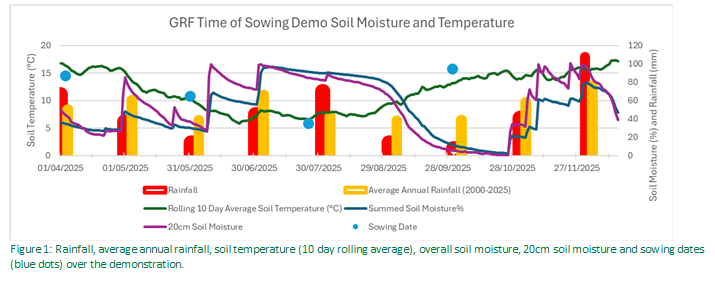
Table 2 and Figure 1 show the soil moisture levels, soil temperature, establishment counts, dry matter production and growth rates resulting from the various sowing dates.
Establishment counts were conducted at different intervals following sowing for each treatment (Time of Sowing (TOS) 1: 10 weeks, TOS 2: 17 weeks, TOS 3: 10 weeks, TOS 4: 9 weeks), reflecting differences in emergence timing.
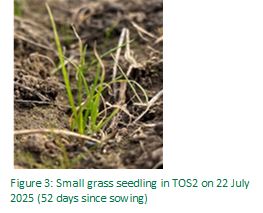
The delayed assessment of TOS 2 was due to slower plant emergence under cooler and drier conditions.
Establishment counts were based on the number of ryegrass plants that had emerged. Ryegrass was the most dominant species to germinate initially at each sowing.
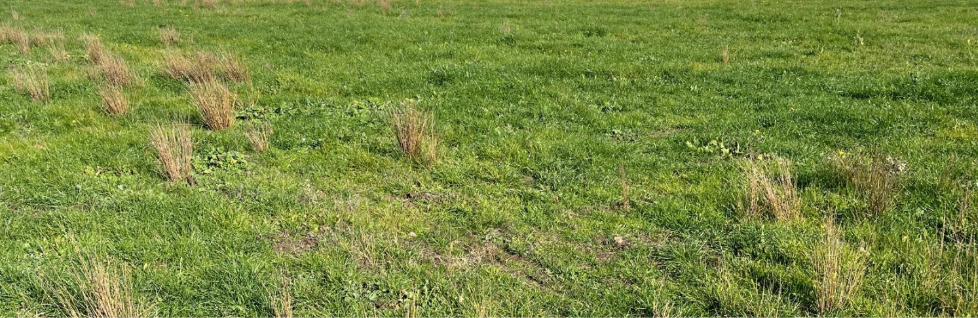
Figure 2: Time of sowing 1 on 12 June 2025.
High soil moisture (91%) at time of sowing 3 resulted in the best establishment counts at 50 plant/m2, although a low soil temperature (6.7ᵒC) impacted the speed of emergence.
Establishment counts are an important guide to determine whether sowing was successful but are not the only consideration. TOS 1 had a lower plant establishment count than TOS 3 (31 plants/m2 compared to 50 plants/m2) due to the low soil moisture level of 35% at sowing.
 TOS 1 produced the most total pasture over the demonstration period (4,214 kg DM/ha), largely due to the longer growing season. When comparing treatments, it’s important to consider both total production and average daily growth rates, as sowing date influences the length of the growing period. TOS 1 still achieved the highest growth rate of 19kg DM/ha/day). Waiting until soil moisture conditions were ideal, TOS 3 produced lower total pasture growth (1,507kg/DM/ha) compared to TOS 1 during the demonstration period. This difference reflects both establishment conditions and differences in growing period.
 The pasture production from TOS 1 provided stock with 2 grazing events. Both TOS 2 and 3 only allowed a single grazing event to occur. Due to the late sowing and low soil moisture levels seen at TOS 4, pasture production was slow and did not allow for a grazing event before the conclusion of the demonstration.
Economic analysis:
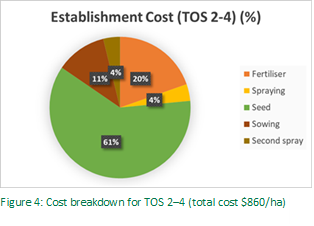
Perennial pasture mixes can be expensive to establish due to the cost of the seed ($525/ha for this seed mix).
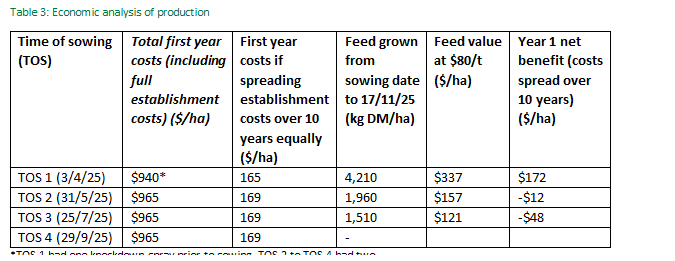
The value of feed produced at different sowing times was compared by valuing standing feed at $80/t (Table 3). Establishment costs were annualised over 10 years.
Despite the moderate establishment, TOS 1 produced the cheapest feed and highest net benefit of $172/ha. This was achieved by having the longest growing season and the highest average growth rate.
Under similar seasonal conditions with a late break, an option to manage risk (when soil moisture is not adequate) is to plant lower cost pasture such as an annual or Italian ryegrass pasture mix. With similar production levels, but lower seed cost, the cost per tonne of dry matter produced would be reduced. However, these systems require more frequent resowing (typically every 12–18 months).
Implications/conclusion
When making sowing decisions, it is important to consider the intended outcome of the pasture (for example, establishing a long‑term perennial versus a short‑term annual), alongside current sowing conditions and the level of risk associated with the timing.
TOS 1 demonstrated that early sowing provides a longer growing season and greater opportunity to utilise rainfall and generate pasture growth. Even with suboptimal soil moisture at sowing, it produced the highest amount of feed and had the highest growth rate.
TOS 3 demonstrated that waiting for adequate soil moisture produced the highest ryegrass germination rate at 50 plants/m2. However, this was at the cost of production both in average pasture growth rate and in total production (kg DM/ha). TOS 3 grew slower as it was restricted by lower soil temperature levels and low soil moisture in early to mid-spring.
Where soil moisture is limited, annual/Italian ryegrass may provide a lower-risk option for generating short-term feed due to the lower establishment cost. This option has good potential where soil temperature is declining and soil moisture is not optimal for sowing.
What’s next?
This PDS demonstrated that additional productivity can be achieved through earlier sowing, even in a dry autumn, due to a longer growing season and higher average growth rates. It also highlighted the value of understanding soil moisture and temperature conditions and their impact on pasture establishment and growth rates.
A follow-up project could investigate differences in establishment and overall production of perennial, annual and Italian ryegrasses sown under varying soil moisture and temperature environments.