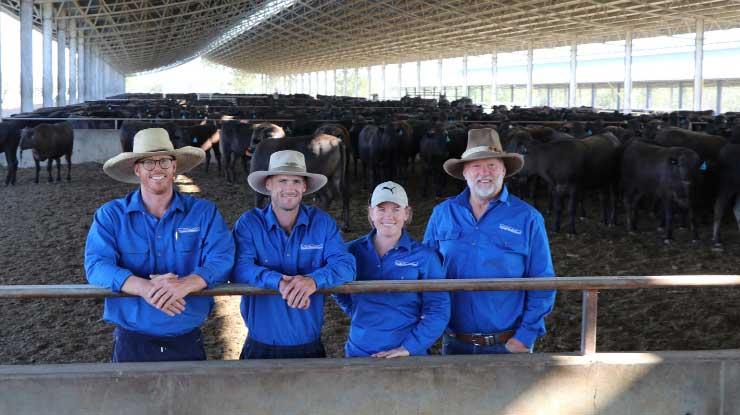
 Siblings (left to right) Jack, Chris Jnr and Sarah manage ‘Canning Downs South’ alongside their uncle and feedlot owner, Chris Shaw (right).
The secret behind a 99% MSA compliance rate
On a 40°C day in Queensland’s Elbow Valley, the staff and cattle at Canning Downs South feedlot remain oblivious to the slap of heat hitting the roof of their shedded enterprise.
With a commitment to animal health and welfare, the Shaw family have transformed their cattle station (purchased in 1998) to a 9,400 standard cattle unit (SCU) capacity covered feedlot and backgrounding enterprise that’s been feeding 100% Wagyu since 2018.
Owner Chris Shaw – who manages the property alongside niece Sarah and nephews Chris Jnr and Jack Shaw – coordinated the construction of the feedlot’s distinctive sheds with the family’s decision to produce their own Elbow Valley-branded beef in 2019.
Now, coming off the back of a recent Meat Standards Australia (MSA) win for the 2023–25 period, the Shaws are sharing the behind-the-scenes tools, resources and strategies that earned them:
- an average MSA Index of 65.97
- a 99% compliance rate
- the Queensland Grainfed Producer Award for Excellence in Eating Quality.
Sheds for all seasons
Farm snapshot
-
NAMETHE SHAW FAMILY – ‘Canning Downs South’, Elbow Valley, Queensland
-
AREA1,350ha
-
ENTERPRISE9,400 Wagyu feedlot
-
PASTURESImproved pastures, Rhodes, fescue, phalaris and native grasses. Feedlot ration includes wheat, barley, silage and orange pulp/peels
-
SOILSDeep alluvial soil, self-mulching soil types and lighter sandy loams
-
RAINFALL680mm
Built by Entegra and modelled for high-airflow, the sheds that host Canning Downs South feedlot are designed to combat the harsh heat of summer and wet winds of winter on Queensland’s Southern Downs – all without sacrificing fresh air and natural light.
According to Sarah, while the decision to build the sheds came from Chris’ desire to improve animal welfare standards, the return on investment from building six sheds over the past seven years has stretched well beyond happy cattle.
“It’s been a huge investment with ongoing costs involved to maintain safe and hygienic conditions for both animals and staff – but it’s all been incredibly worth it.”
With concave roofs that stretch beyond the footprint of the pen and bunks, open ridges and high concrete walls fencing the sheds’ perimeter, conditions are comfortable and manure run-off is minimised at the feedlot.
“In summer, the concave roof and open ridge seem to encourage airflow and keep the heat away – creating an effect that often feels akin to having a fan on at times,” Sarah said.
“In winter, we see an almost opposite effect occur. Increased rainfall and often windy days hit the region during our winters, yet the sheds help keep the pens and animals dry and warm.
Since establishing the sheds, the Shaws have seen significant benefits, from reduced panting and clean coats to improved animal health and wellbeing.
“It’s been a game changer,” Sarah said.
“Year round, our animals are calm, happy and productive – and by default, so are our staff.
One enterprise supplying the other
Another factor which helps keep cattle warm and dry in winter is the deep-litter composting bedding made from locally sourced sawdust which beds the feedlot. It’s reapplied every 10–14 days and boosted with a probiotic every three weeks to maintain hygiene.
“Much like in composting systems, sawdust binds and neutralises volatile compounds and moisture, helping convert them into a stable nutrient-rich compost,” Chris said.
This keeps odour – especially ammonia spikes – to a minimum and floors dry. The Shaws build up the beds for six to 12 months, before pulling it out to spread over pastures in backgrounding paddocks.
In addition to supplying compost, the shed roofs are used to capture rainfall which is stored and used for stock water.
“Our captured rainfall reduces the amount of water we take from our allocations,” Chris said.
“It also provides a better sense of security during drier periods – it’s a win-win.”
A sweet point of difference
The Shaw family sources their feeder steers from one Queensland supplier.
Steers enter the program at about two years of age and approximately 380kg, with milk-to-four teeth.
Once on feed, cattle spend an average of 450 days in the program, progressing toward a target liveweight of about 800kg and a carcase weight of approximately 450kg.
Processing takes place just 20 minutes down the road at John Dee in Warwick, allowing animals to travel short distances and arrive with minimal stress – another deliberate choice that supports the family’s animal-welfare focus.
From there, the beef is channelled into the Shaw’s two premium brands – Sir Harry Wagyu and Chauvel Wagyu – which reach both domestic and global consumers.
While Chris considers his positive relationship with his suppliers and processor are pretty sweet, his consumers would argue it’s the delicate flavour of the family’s beef that’s sweeter.
At Canning Downs South, feedlot rations are built on wheat, barley and silage which is grown on the family’s nearby 1,000ha cropping block, with a distinctive inclusion of fresh orange pulp and peel.
“The orange pulp and peel are byproducts of Grove Juice, which is 20km from us in Warwick,” Chris said.
“We’ve been their offtake for their by-products since they opened 15 years ago, and we really value the role they’ve played in our feeding story.”
According to Chris, lab testing citrus pulp in feed has shown a significant increase in lipophilic antioxidants such as α-tocopherol in cattle – an important E-vitamin and antioxidant that helps protect meat from fat oxidation and keep its colour brighter for longer.
“Higher vitamin E levels also support the body’s ability to manage oxidative stress and, as many studies suggest, nutrient-dense food tends to deliver better flavour too,” he said.
“Another component enhancing that flavour and tenderness is the reduction in fat melting point that orange pulp supplies.
“Wagyu fat normally melts at around 25°C, compared to 40°C for commercial beef fat, and the orange pulp lowers that even further.”
The pulp and peel have also delivered health benefits, with Chris noting increased hydration and reduced Bovine Respiratory Disease (BRD) in their cattle.
“This may be a result of the sheds and orange pulp combined, but what’s clear to us is when animals are healthy, hydrated and stress-free, everything else – growth, marbling, welfare and eating quality – simply falls into place.”