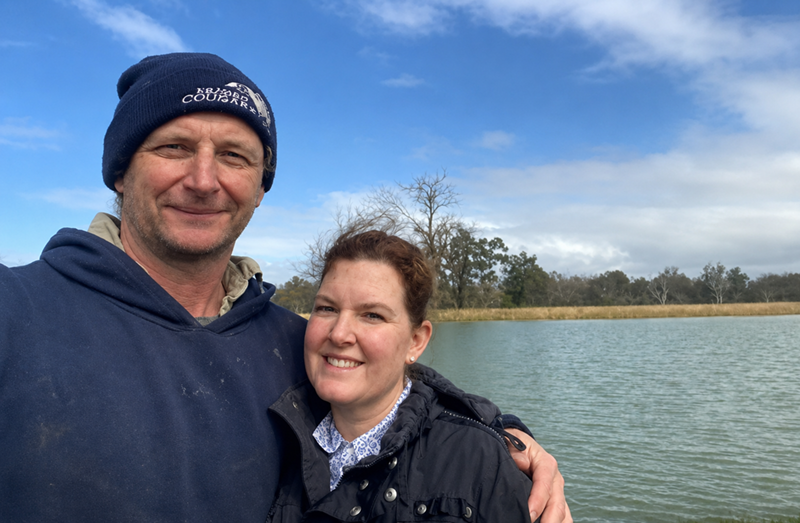
 Ben and Emily Webb run a mixed cropping and Merino enterprise, integrating stubble grazing to improve feed utilisation.
Making stubbles work harder in mixed systems
Stubble grazing has always been a focus for WA mixed farmers Ben and Emily Webb – but until recently, it was largely managed by experience and visual assessment.
Now, they’re taking a more data-driven approach, using liveweight monitoring to better understand how long stubbles deliver value and when to intervene.
This shift has come through their involvement in the MLA and GRDC Producer Demonstration Site (PDS) Optimising stubble grazing strategies in the Great Southern, delivered in partnership with Southern Dirt.
The Webbs’ property in the high rainfall zone at Kojonup in WA’s Great Southern region combines cropping and a Merino sheep operation.
They crop the more productive country while running sheep across permanent pastures and less arable areas.
Like many producers, Ben sees stubble grazing as essential to maintaining stocking rates while protecting pastures over summer.
“It allows us to run a higher stocking rate because we can put the sheep somewhere over the summer. Without those stubbles, it would put too much pressure on the pastures,” he said.
This aligns with broader project findings that stubbles can play a critical role in bridging the summer–autumn feed gap and reducing reliance on supplementary feeding.
From ‘set and forget’ to measured management
Traditionally, Ben’s approach to stubble grazing was straightforward. He used large mobs to graze paddocks sequentially until feed ran out.
The PDS introduced a more structured approach, centred on weekly liveweight monitoring.
With existing infrastructure from his ram breeding enterprise, including auto-drafting and electronic identification (eID), Ben was well placed to adopt the system.
“We had the set up so it was quite simple. We just ran them in and weighed them,” he said.
This shift reflects a key project insight, that liveweight change is the most reliable indicator of nutritional value, often outperforming feed tests or visual assessment alone.
What the data revealed
For Ben, feed testing results largely confirmed expectations but importantly, they added confidence and clarity.
“Feed testing reinforced what we hoped was right and put some numbers around the quality – it was actually slightly better than I expected,” he said.
Across the broader project, feed testing highlighted a clear nutritional hierarchy in stubbles, with grain driving early performance and lower-value components contributing less as grazing progresses.
However, it was the liveweight data that proved most valuable, by clearly showing when animal performance peaked and began to decline.
Findings across the PDS sites demonstrated that:
- sheep typically achieve strong early gains (100g/head/day)
- performance peaks around 20–30 days of grazing
- liveweight then stabilises and declines as feed quality drops.
This reinforced to Ben the importance of timing grazing rotations and supplementation decisions carefully.
Applying the learnings on-farm
For Ben, being involved in the PDS has helped him better predict how long different stubbles will last and how they perform.
“I’d like to see how the wheat compares to the barley, so we can work the numbers out around that and how long the paddocks will last,” he said.
This level of insight allows for more proactive decision-making, including when to move stock or introduce supplementary feeding.
Rather than reacting to declining condition, Ben is now aiming to anticipate it.
The demonstration has also reinforced the value of quantifying management decisions.
Why producer-led demonstrations matter
Ben’s involvement in the project came through his connection with Southern Dirt, but he sees clear value in participating.
“I always like looking for ways to improve or getting a bit more out of it. It’s good to meet different people and get some numbers around what you’re doing, so you know you’re on the right track,” he said.
Five steps for stubble successBen’s involvement in the PDS reinforces several practical lessons for producers looking to improve their stubble grazing strategy.
|
As pressure grows to lift efficiency and reduce feed costs, stubble grazing is becoming less of a fallback and more of a planned component of mixed farming systems. Applying a data-driven approach ensures this resource is used to its full potential.