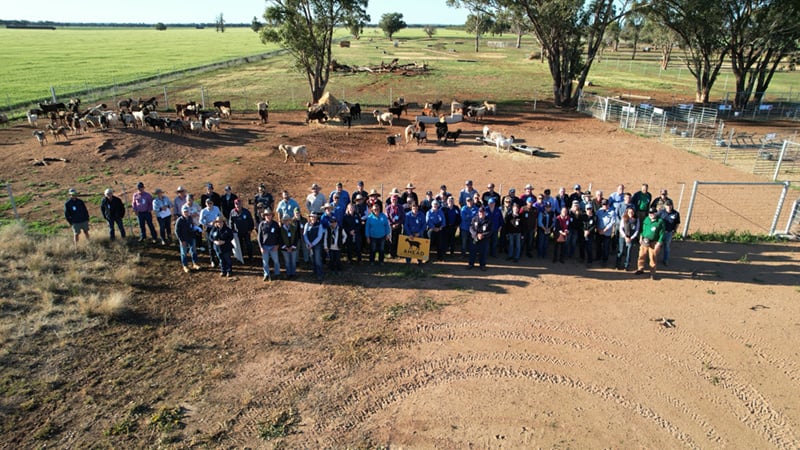
 Come along to the 2026 Measured Goats Field Day to explore new genetics insights, practical breeding tools and opportunities to improve herd performance. Image credit: D. Reardon
Which bucks deliver the biggest returns? Learn more at Measured Goats
The Measured Goats Field Day is one of the largest and most comprehensive goat genetics research programs undertaken anywhere in the world – and it’s taking place right here in our own backyard.
The project delivers modern selection tools to the industry and has established a genomic reference herd to underpin genomic prediction.
Sires have been sourced from across industry including, Rangeland, Boer, Kalahari, Contender, Savannah and crossbred goats. To date, three of the five planned kidding rounds have been successfully completed.
This reference herd is based at the NSW DPIRD Condobolin Agricultural Research and Advisory Centre, who are preparing to welcome more than 100 goat producers, researchers and industry stakeholders to the annual Measured Goats Field Day on Wednesday 16 September.
To date, the program has recorded more than 260,000 data records from 5,421 research-bred progeny and 1,329 industry-sourced goats.
These insights have allowed researchers to quantify genetic variation in economically important traits and develop tools to assist producers in identifying and selecting the top-performing animals within their herds.
The key findings from the reference herd and complementary research involving measured goats will be presented at September's field day.
Key findings
The results have revealed the large amount of genetic variation in Australian goats, which enables rapid genetic progress.
For example, there is a 17kg genetic range between the highest and lowest sires for body weight at nine months of age (post-weaning weight).
While meat breeds generally have higher Post Weaning Weight (PWT) estimated breeding values (EBVs) than Rangeland goats, researchers have found that the best-performing Rangeland bucks can outperform lower-ranking meat breed sires.
The research highlighted the importance of selecting superior individual animals rather than relying solely on breed when making breeding decisions.
|
Researchers have also found:
|
New opportunities for producers
Measured Goats provides new opportunities to accelerate genetic improvement and tools to support informed breeding decisions, including the world's first genomic prediction for goatmeat breeds.
One of the easiest ways producers can immerse themselves in this content is through attendance at the 2026 Measured Goats Field Day.
Presenting new and insightful information in this forum, the Measured Goats Field Day will cover:
- The next big step: Genomic prediction: a game-changer for industry, genomic prediction can anticipate the performance of an animal’s progeny.
- Selecting better bucks: variation in growth Estimated Breeding Values (EBVs) - the difference selecting the right bucks can make to your bottom line.
- Crossbreeding: quantify the benefits of hybrid vigour
- Turning variation into value: explore carcase variation and supply chain opportunity
- Improving reproductive efficiency: selecting bucks that breed daughters who wean more kids
A key focus of the field day will be the female animals with researchers providing the industry's first insight into the reproductive performance of research-bred female progeny.
Researchers will also present findings on the relationship between udder traits, including teat number, size, attachment and depth, and kid survival.
The field day will bring industry together to hear the latest research and explore how modern selection tools can be used to identify top-performing animals and capitalise on the genetic variation within the Australian goat herd.
The program will combine research updates with practical demonstrations, as well as plenty of opportunities for discussion and networking.
Details
Date: Wednesday 16 September 2026
Time: 8:30am to 4:30pm (registration from 8:00am)
Location: Condobolin Agricultural Research and Advisory Centre, 152 Fifield Road, Condobolin NSW 2877
Registration: Please register your interest here.
For more information, access the event program here and register your attendance here.
Further enquiries can be directed to Trudie Atkinson at trudie.atkinson@dpird.nsw.gov.au or 0427 102 431.