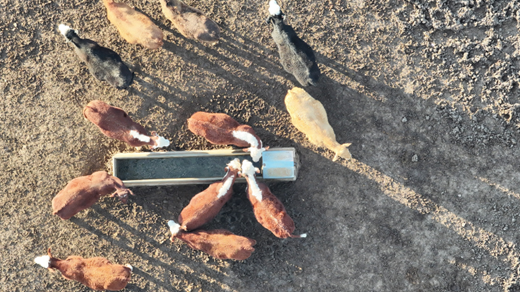
 Image captured by autonomous drone, allowing JBS staff to monitor water levels and cleanliness.
Eyes in the sky increase on-farm productivity
In an effort to explore how digital tools can enhance operational efficiency and animal welfare, JBS Australia is trialling autonomous drone technology at two of their feedlots and adjacent farm and processing sites in NSW and Queensland.
Backed by Meat & Livestock Australia (MLA) and powered by Perth-based tech company Sensorem, the initiative is part of a broader push to bring cutting-edge remote sensing into the red meat supply chain.
“Supporting partners like JBS to trial technologies like drones is an example of how we are keen on exploring solutions that provide efficiencies as well as generate new sources of digital sensing data,” MLA’s Digital Agriculture project manager John McGuren said.
According to JBS’s Head of Innovation Sean Starling, JBS introduced drones to their Yambinya and Beef City feedlots with hopes of increasing site monitoring while giving time back to staff – enabling them to direct more focus towards animal care and site management.
“At Yambinya, it can take a staff member six hours to physically inspect water troughs, cattle and other infrastructure,” Sean said.
“This time-intensive commitment makes it difficult to increase the frequency of monitoring – one full rotation can take up most of that staff member’s working day.”
While drones seemed like a practical solution, introducing them came with its own set of challenges.
“Manual drone operation and reviewing the footage still required significant time investment each day,” he said.
“While monitoring is essential to our operations, our team’s core strengths lie in data analysis and decision making, not piloting drones.”
That’s where autonomous technology came in.
“By removing the need for manual piloting, we’ve reduced the time spent on property-wide monitoring from six hours to less than one – giving our staff more time to focus on what they do best, while allowing us to check on our cattle and infrastructure more frequently.”
How it works
According to Sean, Sensorem’s ‘drone-in-a-box’ (DiaB) system is designed to operate independently.
Similar to the concept of the robot vacuum cleaner, Sean said the borders of the two feedlots – Yambinya and Beef City – are mapped out as approved flight zones, with no-fly areas marked over homesteads to protect privacy.
Once flight paths are established, the drone flies autonomously, capturing high-resolution images and video across the site.
These visuals are then reviewed by remote pilots from Sensorem, who provide feedback on infrastructure and livestock conditions for JBS staff to then act on.
“Each drone launches from a weatherproof pod, flies a programmed route, and returns to recharge – all without on-site piloting,” he said.
“The pod itself has an inbuilt camera, Starlink satellite, and weather station.”
“If unsuitable flying conditions like high winds or rainfall are detected, the drone will automatically delay its routine journey.”
“If required, staff will take on manual monitoring during longer periods where weather conditions prevent flying.”
To ensure data security and site privacy, Sensorem has undergone extensive cybersecurity assessments.
Protocols are in place to protect the communication link between the drone and staff operators, as well as the visual data captured and stored.
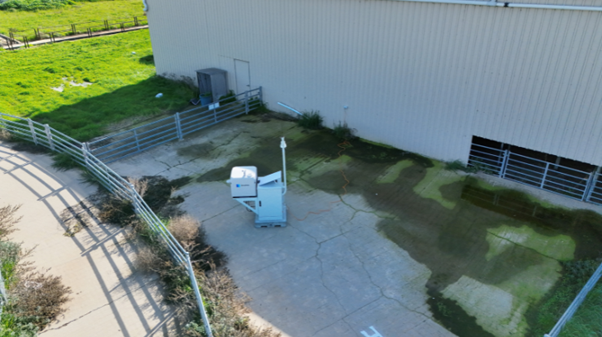
A weather proof pod acts as the home base for the drone, fitted with inbuild camera, Starlink satellite, and weather station.
Quicker reaction times
Since implementation, Sean said JBS has experienced a marked improvement in site-wide visibility – enabling site teams to access timely, high-resolution imagery that supports faster and more informed decision making.
“The ability to receive near real-time visual data has enhanced our responsiveness and allowed us to prioritise resources more effectively,” Sean said.
“By shifting routine monitoring to automated systems, staff can focus on core responsibilities, with remote footage review ensuring insights are delivered without disrupting day-to-day operations.”
“This technology is helping us move from reactive to proactive management,” he said.
“It’s about equipping our teams with the right information at the right time to make the right decisions.”
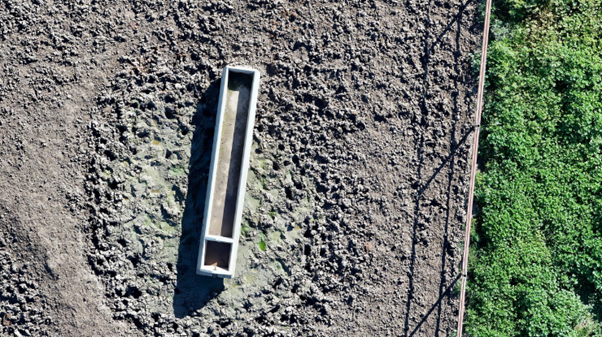
Footage captured by the drone made JBS staff aware of a water leak in one of their troughs – enabling informed decision-making.
New flight paths
As the trial evolves, so do the drone missions. Each feedlot has its own set of objectives, documented in detailed mission handbooks that outline flight schedules, target areas, and operational constraints.
According to Sean, these handbooks are updated regularly as JBS and Sensorem learn what works and what doesn’t.
“We’re hoping to upgrade our drones’ capabilities from just automated flying, to identifying hazards or areas of potential concern,” he said.
“Instead of relying on humans to consistently review footage to identify things like a leaking water tough, we want to teach our drones to recognise what they’re recording and notify our staff.
“The idea is that once the drone spots something that could be of potential concern, the system then notifies our staff immediately via an email along with captured footage – ultimately allowing for an even quicker response time.”
As part of this AI development goal, Sean said they are looking to begin using drones to monitor feed levels in bunks with additional hardware.
Despite early challenges, JBS remains committed to exploring how AI-driven technologies can support staff by streamlining routine tasks and enabling greater focus on core operational priorities.