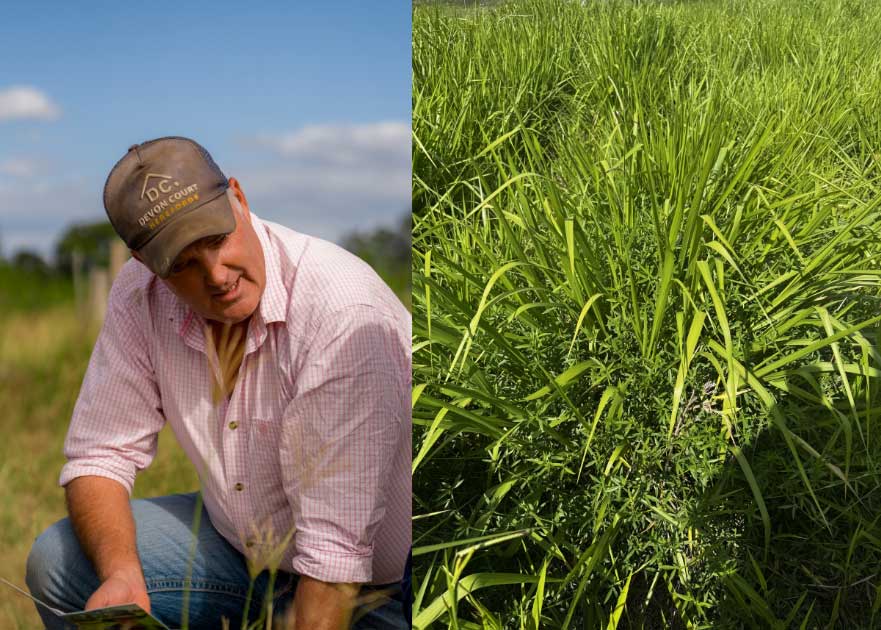
 Image: According to Ross Newman, adding legumes to your feedbase can provide high quality and protein-rich forage that boosts livestock nutrition and productivity.
More legumes, greater liveweight gain
With a background spanning plant science, seed production and pasture dieback, agronomist Ross Newman has seen firsthand how introducing legumes can transform productivity for northern producers.
Based in central Queensland – but having experience with pasture systems across the nation – Ross said there’s been a noticeable decline in the quality of grass-based pastures across the north, with many producers claiming their once successful pastures just aren’t cutting it anymore.
“Over time, organic carbon and moisture levels have declined in our northern soils, impacting the quality and quantity of pastures produced,” he said.
“However, research and practical case studies have shown us that the introduction of legumes can rebuild that foundation in a way that improves productivity beyond our pastures.”
Here, he discusses how to successfully introduce legumes to your feedbase, and the long-term outcomes they can provide.
Back to the basics
When it comes to achieving the benefits legumes can provide, Ross said it starts with selecting the right species for your climate.
“There is no one size fits all unfortunately,” Ross said.
“Annual rainfall patterns, soil types and fertility, seasonal temperatures and frost risk all influence whether a legume will persist and perform.”
However, Ross said there are plenty of great resources online via MLA and FutureBeef, as well as local government departments.
“If you’re unsure, seeking advice from your agronomist is always beneficial – especially if you want that best change in return on investment.
“Also, conducting a basic soil test to get an understanding of your soil constraints and potential will also help identify the most suitable cultivar.”
Once you’ve picked the right legume for your land and invested in a high-quality seed, Ross said the next vital step is preparing the seedbed.
“Poor land preparation is one of the biggest pitfalls I see on-farm, with small-seeded legumes failing to establish in competition with existing grasses.”
To avoid this, Ross suggests producers:
- Reduce grass competition prior to sowing through heavy grazing, cultivation or herbicide application where appropriate.
- Sow seed shallow, as many tropical legumes are small-seeded and can struggle to emerge if planted too deep.
- Time planting to seasonal conditions so there is adequate soil moisture for germination and early establishment.
- Limit grazing pressure during the first six months after sowing to allow legumes to establish strong root systems.
- Continue to monitor grass competition post-establishment and adjust grazing land management accordingly to ensure adequate sunlight and rest are received.
“Depending on the location and rainfall reliability, storing soil moisture through a fallow period may also be beneficial to achieving success,” he said.
Cattle gain greater weight, you gain greater productivity
According to Ross, the productivity benefits of legumes become most noticeable not within the extension of your pasture life quality, but through the improvement of your livestock performance. This is particularly evident through the dry season when grass quality begins to decline.
“Unlike grasses, legumes are able to continue drawing moisture from deeper in the soil profile – allowing producers to maintain diet quality for longer and continue achieving weight gain later into the dry season,” he said.
Referencing an MLA-supported Queensland weight gain trial completed at ‘Fairview’ in central Queensland, Ross said the benefits of introducing legumes into northern grazing systems had been well demonstrated over the years.
“Traditionally, producers introducing legumes into northern systems have seen an additional 20-50kg of liveweight gain annually.
“This often coincides with reduced reliance on supplementation, improved carrying capacity, and the ability to meet market specifications sooner.
“In the ‘Fairview’ trial, steers fed on leucaena gained 100kg/head over six months.
“In comparison, steers grazing a native grass-only pasture gained just 37kg/head over the same period – highlighting the performance lifting power on well-established legumes.”
Managing for the long haul
While effective, Ross said legumes are not a quick fix but an ongoing investment.
“When legumes are managed properly within the grazing system, they can completely change the productivity of a paddock – but their long-term capabilities are dependent on grazing land management that enables rest and recovery,” he said.
Ross explained that tropical legumes and grasses have variations in palatability and acceptance throughout the year, so all components of the system require monitoring.
“That means producers often need to be vigilant and rotate their herd based on legume grazed, rather than broad pasture availability – especially if you don’t want to find yourself right back at the start after having all your newly established legumes grazed out.
“It’s an investment – particularly a time investment – but it’s one that pays off through improved productivity and profitability in the long-run.
“The producers who commit to managing legumes well are often the ones seeing continued gains year after year, whether that’s through stronger cattle performance, improved carrying capacity or more resilient pasture systems.”