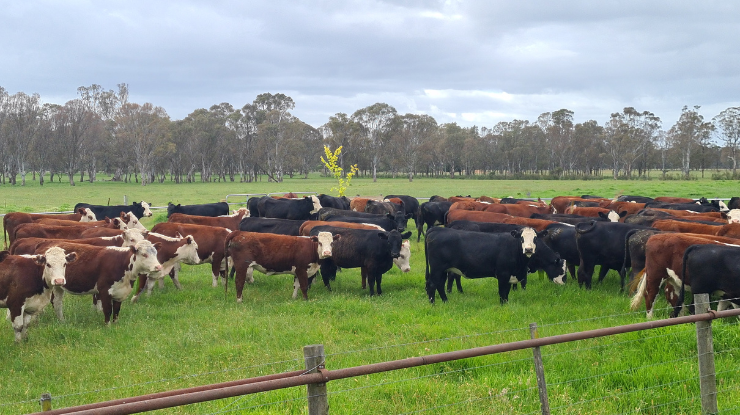
 Improved soil productivity supports Trevor and Carryn’s self-replacing breeder herd.
Building productivity through better soil
Victorian beef producer Trevor Caithness describes soil health as the red meat industry’s sleeping giant – one he’s tackling through an on-farm trial.
“It’s slow work, but the returns are exponential,” he said.
Trevor has always seen soil health as the foundation for consistent livestock performance. As part of a Meat & Livestock Australia (MLA) Producer Demonstration Site (PDS), he’s opening the gates of his east Gippsland property to share how focusing on soil amelioration can maximise red meat production.
Hosting one of four demonstration sites as part of the Gippsland Agricultural Group’s five-year PDS was a natural extension of what Trevor was already doing on-farm.
The family-run Caithness Pastoral incorporates 1,600ha of variable soils, ranging from red gum flats with drainage issues to sandy loams with low fertility. The enterprise includes a self-replacing herd and a dryland cropping program.
In the face of increasingly unpredictable weather patterns, Trevor has made proactive soil management the foundation of his decision making.
PDS builds knowledge
Trevor sees the PDS as a practical way to contribute to regional knowledge, while testing his own approach.
“The soils on the red gum plains have always been a challenge – but if you don’t invest in your soils, you’re just managing symptoms,” Trevor said.
“The real productivity – the long-term resilience – comes from what’s happening below the surface.”
Trevor’s experience has shown him there’s little benefit in delaying action on soil improvement.
For newly acquired blocks, he applies a full amendment program upfront of 3.5t/ha lime, 1.5t/ha gypsum, 2t/ha poultry litter and trace elements (copper, zinc, selenium, cobalt).
“Waiting five years for a paddock to come good isn’t an option. The interest bill doesn’t wait,” he said.
Trevor draws on the Albrecht–Kinsey soil fertility system and his experience as a 2002 Nuffield Scholar. He believes reading and understanding soil tests is a critical skill for producers.
“A well-balanced soil doesn’t just feed plants, it protects them. We see stronger pasture resilience, better livestock performance and minimal animal health issues. We also have more water-holding capacity in extreme dry events,” he said.
Infrastructure investment
Gippsland’s increasingly variable climate has informed Trevor’s infrastructure investments. He’s installed a reticulated bore water system and built a large silage pit to conserve fodder during favourable years.
Containment feeding is a core strategy, with stubble paddocks used to hold cows early in the season while preserving pasture and annual crops for silage.
“It’s about maximising kilograms of red meat per hectare, profit per breeder and leveraging the synergies between livestock and grain,” he said
Two-way value
Hosting the PDS has deepened Trevor’s understanding of his own system and opened the door to exchanging ideas with other producers.
“You get value when you give value. We’re not just doing this for our farm, we’re helping build a more resilient industry,” he said.
Trevor relishes the field walks and discussions with other PDS hosts and observers.
|