What’s been driving growth in the Feeder Steer Indicator?
Key points
- The Feeder Steer Indicator has outperformed other cattle indicators over the last month lifting 7.5%.
- Feeder steer supply has sat at an average level looking at year-to-date averages since 2014.
- Growth in lot feeding, a lift in competition from producers and impacts of low global supply drive the indicator.
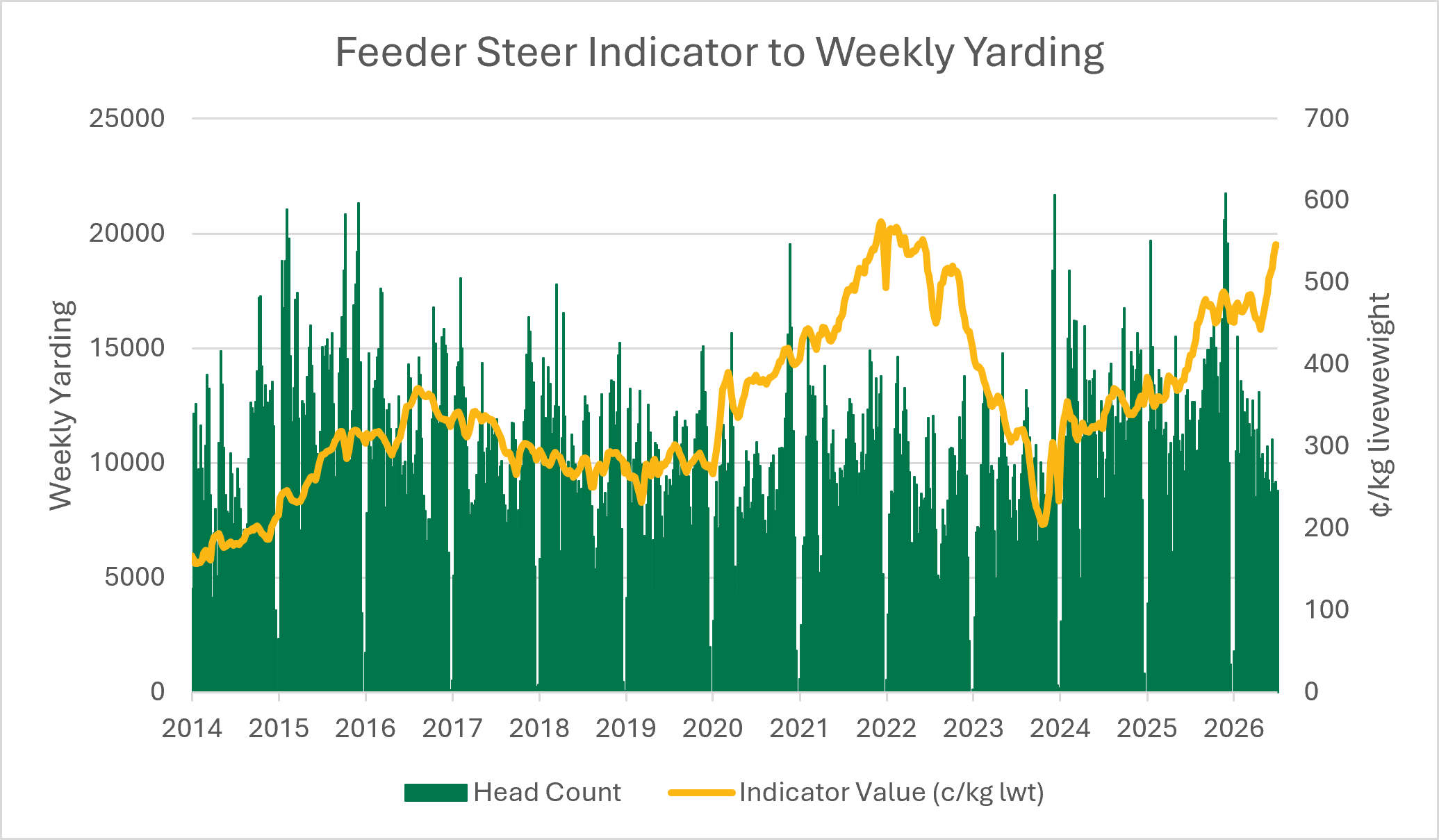
This week, the Feeder Steer Indicator sits at 544¢/kg liveweight (lwt), lifting 38¢ (+7.5%) over the last month to approach the record of 576¢/kg lwt set back in December 2021. All cattle indicators outside of the Dairy Cow and Processor Cow have lifted over the last month, from between 2.5% for the Restocker Yearling Heifer Indicator to 6.5% for the Restocker Yearling Steer Indicator, while the Heavy Steer Indicator remained stable.
Evaluating feeder steer supply at saleyards since 2014, year-to-date (YTD) (at 28th week of the year) 2026 sits 1% above the average, with 287,755 head going through saleyards this year against an average of 285,891 head. However, 2024 and 2025 were significantly higher at 323,962 and 318,321 head, respectively.
The drivers lifting the Feeder Steer Indicator
Growth in feedlot demand
While the saleyard supply of feeder steers is still sitting at the average level since 2014, significant investment in the lot feeding sector has also lifted demand for the category. The Australian Lot Feeders’ Association (ALFA) and Meat & Livestock Australia’s (MLA) most recent March quarter National Feedlot Survey showed turn-off of grainfed beef reached over 1 million head for the first time in a single quarter at 1,046,717 head.
Read the March quarter National Feedlot Survey results.
Impact of low global supply and China quota
Australia’s position to fill a limited global supply shortage of beef has also helped to elevate all cattle indicators over the last 12 months.
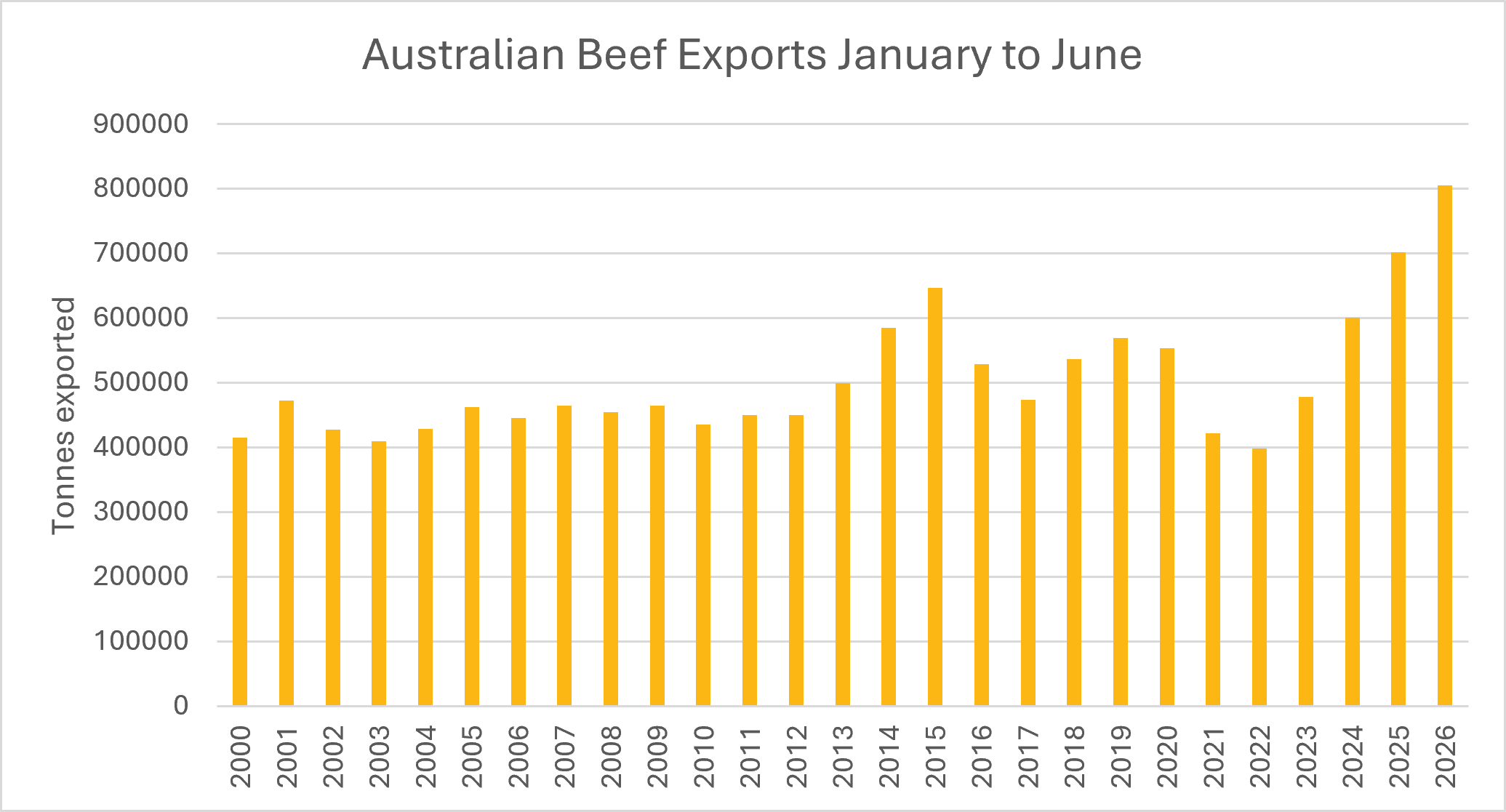
China’s tariff quota on major beef exporters for the calendar year 2026 created an incentive for exporters to race each other into the China market, leading to the highest level of beef exported in the first six months of the year since 2000.
From the start of 2026 to the end of June 2026, Australia had exported 805,000 tonnes of beef, beating the previous record of 2025 by 103,000 tonnes. With the China quota now exhausted for the current calendar year, the feeder steer market comes into strong focus as China heavily favours Australia’s grainfed product. Feedlots purchasing now will be well placed to finish cattle around the new year when China’s tariff is due to expire, supporting a basis in current demand.
Attribute content to: Alex Fry, MLA Market Information Analyst.
Information is correct at time of writing on 10 July 2026.