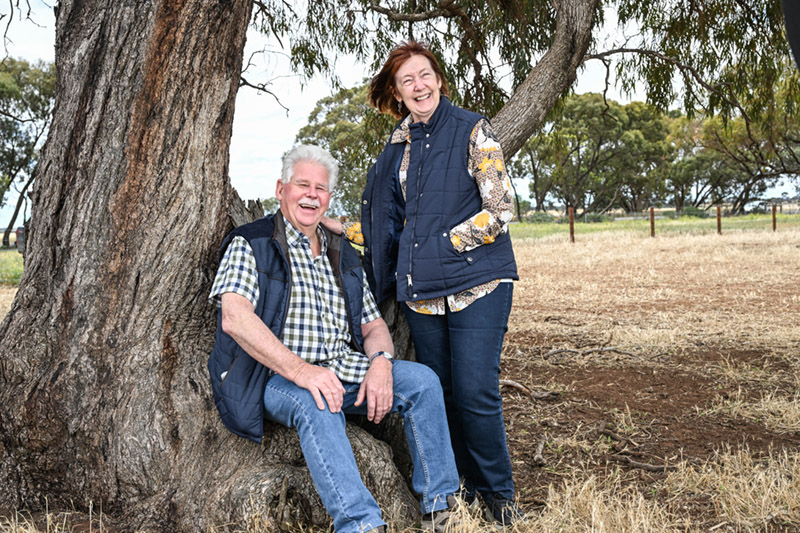
 Greg and Lynn Walsh at the Roseworthy Field Day hosted in Adelaide alongside the 2025 MLA Updates. Image: Brenton Edwards
Small operation, standout results: the power of consistency
For Victorian beef cattle producers Greg and Lynn Walsh, keeping consistency in best practice herd and land management on-farm has been the key to being recognised for their Meat Standards Australia (MSA) results.
Over the 2023–25 MSA reporting period, Greg and Lynn consigned 132 head and had an average MSA Index of 63.48 and compliance of 99%. This earned them the title of Victoria’s best Smaller Non-Grainfed MSA Producer in the recent MSA Excellence in Eating Quality awards.
Farm snapshot
-
NameGreg and Lynn Walsh
-
LocationYinnar, Victoria
-
Area in hectares64ha
-
Enterprise100 head of predominately Angus and some Hereford and Hereford-cross cattle for agistment feeding
-
PasturesNon-irrigated ryegrass and clover
-
SoilsLoam to light clay loam
-
Rainfall730-770mm
Two decades of data
The couple’s property at Yinnar in South Gippsland has been in the family for more than 120 years.
Greg – who is a fourth-generation producer and the third generation to manage their property – and Lynn were early adopters of the MSA program in 2004.
Greg credits their stock agent of 45 years for initially bringing the program to their attention.
“He knows our property and its carrying capacity. He recognised that, as a smaller operation, we had more incentive to focus on quality over quantity,” Greg said.
“MSA could give us benchmarks for quality we could strive for and enable us to guarantee a standard for our consumers.”
Around the same time the Walshes became MSA registered, they made the switch from breeding for the domestic veal market to finishing steers.
They later became accredited with the Greenham Never Ever Beef Program and JBS Farm Assurance program.
Today, their stock agent helps the pair source young steers – ideally in the 280–350kg weight range – from the Gippsland region for backgrounding.
“We prefer Black Angus cattle but have stocked Hereford and Hereford-cross at various times,” Greg said.
“Our cattle are 100% grassfed to a target liveweight of 650-720kgs. We track this process by recording weights every time cattle are yarded,” he said.
“We consistently review our MSA carcase data to benchmark performance and help inform future buying decisions.”
A focus on wellbeing
Where possible, Greg said they closely adhere to MSA stock management guidelines.
“We’ve incorporated guidelines heavily into our standard routine,” he said.
“From the moment they arrive (usually late summer/early autumn), cattle are vaccinated, drenched, tagged, weighed and given a B12 selenium supplement due to high risk of deficiency in our region.
“We like to keep a proactive approach to managing the health and wellbeing of our cattle,” Greg said.
“We’ve been in the area long enough to know what poses risk, and we’ve been in the industry long enough to know the value and importance of well cared for animals.”
A lot of Greg’s animal wellbeing practices were inherited from his father, who ran the property as a dairy farm.
“There’s a lot of cross over between the two industries with regards to caring for and educating stock,” he said.
“This includes getting livestock accustomed to people earlier on, and prioritising routine when it comes to yarding and paddock procedures.
“We also aim to keep the people who interact with them during husbandry procedures familiar and have modified our stockyards for smoother operations – really doing our best to ensure a low stress environment.”
Nutrition needs met
Well-planned feedbase management strategies are integral to ensuring good nutritional supply for their stock.
As they run a 100% grassfed operation, Greg and Lynn play close attention to their pastures and soils.
“Avoiding overstocking is incredibly important to maintaining our feedbase,” Greg said.
“We utilise data collected from soil testing, consult with local fertiliser suppliers (often getting them on-farm), and separate cattle based on weight in order to maintain pasture quality.”
They also produce their own silage and hay to utilise as supplementary feed, and ensure any changes to diet are introduced gradually
“When we’ve made changes to their diet in the past, we’ve done so gradually to keep stress levels down.”
To further ensure adequate feed supply and high-quality pastures year-round, Greg and Lynn carry out tree planting for shelter belts and recently completed a reinstatement of a bio-diverse corridor on a natural watercourse – which is reducing erosion and providing shelter.
“We are very fortunate to have town water connection to our troughs, but we still need to rely on rainfall for our feedbase,” Greg said.
“The biggest constraint is soil runoff during higher periods of rainfall, which impacts the quality of our pastures.
“By increasing our biodiversity and improving land contouring, we’ve grown a great feed foundation that turns off a quality product for our consumers.”