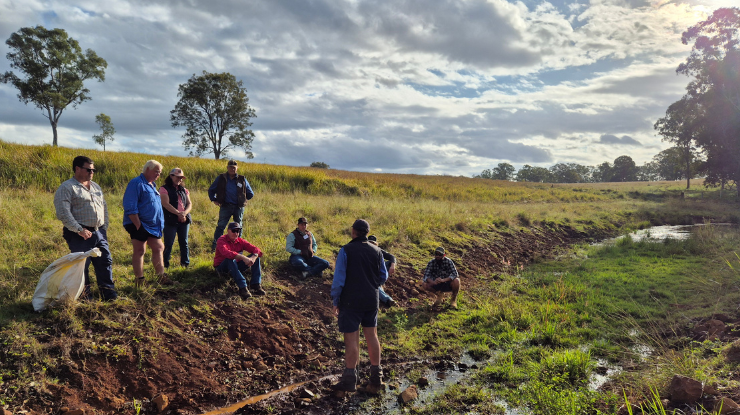
 Casino Food Company members focused heavily on improving landscape hydration throughout their independently run carbon project.
No more chasing credits: Casino bets on soil benefits
When producer-run Casino Food Company first started researching low or carbon neutral farming options, their goal was simple. They wanted to develop a modelled approach to estimating soil carbon sequestration that generated cost-effective carbon credits to improve market outcomes.
A cooperative advantage
Located in the Northern Rivers region of NSW, the Casino Food Company is Australia’s largest meat processing cooperative – currently bringing together 465 shareholders.
They initiated an MLA Co-Innovation project, which wrapped up at the end of 2024. Project lead and Casino Food Company Member Services Manager Joseph Leven said the company’s reach meant it had the benefit of independently trialling the practical application of multiple aggregated soil carbon sequestration projects within a commercial supply chain.
“For many producers, developing carbon credits under one of the existing systems is too costly,” Joseph said.
“Our goal was to find a more affordable solution for the industry, a way to quantify the environmental credentials we achieved without breaking the bank.”
Finding the real value of carbon
As the project progressed, Joseph said it became clear that carbon itself wasn’t the value proposition – it was the outcome of something with even more impact.
“We realised pretty quickly that carbon isn’t the headline when it comes to improving land productivity and profitability,” Joseph said.
“If you focus on improving soil health, landscape hydration and biodiversity, carbon reduces naturally.
“Regardless of the carbon credits, implementing these practices wasn’t just environmentally beneficial – it was economically sound.”
While the project confirmed that producers could generate positive environmental outcomes, it also highlighted the limitations of existing carbon market mechanisms.
“We still don’t have a reliable, cost-effective way to measure soil carbon change,” Joseph said.
“The variability in soil types across even a single paddock makes modelling difficult.
“To get accurate data, you need intensive sampling, and that drives costs through the roof.
“Even if producers could afford the upfront investment, the market wasn’t offering a clear return.
“There’s no guarantee of a premium.
“Buyers aren’t paying more for carbon-neutral beef, they just expect it – it’s becoming a baseline standard, not a differentiator.”
A shift in mindset
According to Joseph, the project’s most valuable outcome may be its shift in perspective.
“Instead of trying to fit producers into carbon frameworks, it validated what many were already doing and gave them confidence to keep going,” he said.
“For the company, the value in simply doing it was much greater than the value of certifying it.”
As a result, Joseph said the co-op is now focused on supporting its shareholders to continue improving their landscapes, knowing that carbon benefits will follow.
“Carbon is a great means of measuring success,” he said.
“But the real value of that success is the improved soil health, increased landscape hydration and pasture availability on-farm, and riparian restoration that boosts productivity in both the land and the animals.”