The next frontier: Animal welfare in feedlots
Australia’s feedlot sector has long excelled at collecting data. From induction records to treatment histories, the industry has built a strong foundation for understanding animal performance. But as feedlot veterinarian and researcher Tony Batterham, Apiam Animal Health argues, the next leap forward won’t come from gathering more information; it will come from using it in a fundamentally different way.
“Historically, we’ve done a very good job but have done it in a very descriptive way. We’ve been very good at monitoring what has happened,” Tony said.
The challenge now is shifting from retrospective analysis to predictive, proactive animal health management.
Why prediction matters more than description
Bovine respiratory disease (BRD) remains one of the most persistent and costly issues in feedlots worldwide. Despite decades of research and improved management, the industry still loses significant numbers of cattle to undetected or late‑detected illness.
Tony highlights a confronting statistic from a two‑year dataset: more than 10,000 BRD deaths were recorded, and “44% of the cattle died this way” – without detection or with detection that came too late. This pattern shows the limits of traditional observation based systems, even in well run operations.
Predictive analytics offers a way to identify high risk animals earlier, allocate labour more efficiently, and reduce both mortality and morbidity. It also supports sustainability goals by improving welfare outcomes and reducing unnecessary antimicrobial use.
Machine learning as a new health tool
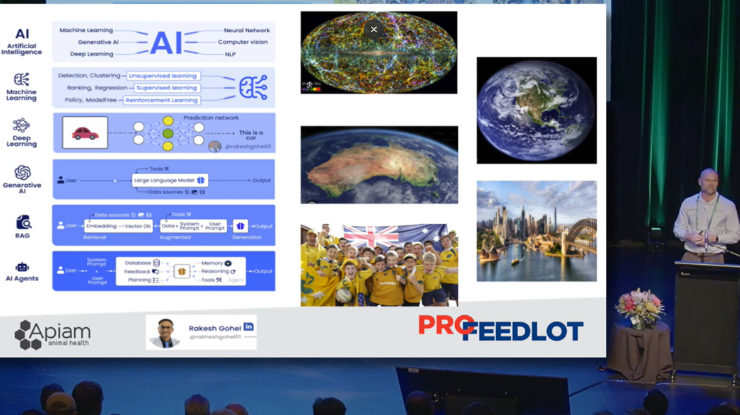
Tony explained artificial intelligence as a hierarchy – from broad AI to machine learning, to deep learning, to generative AI – with each layer more specialised and more powerful.
Machine learning models can analyse thousands of data points from induction, cattle sourcing, weather, and management with the potential to estimate an animal’s likelihood of developing BRD.
“What the model does is learn how to map the combinations of those explanatory variables to that targeted outcome,” Tony said.
Early modelling trials show promise, but they also reveal the complexity of predicting animal health outcomes.
BRD deaths are low prevalence events, making them statistically difficult to model. Key information, such as immune status, weaning method, backgrounding history, or pre‑vaccination, is often missing from current records.
“We don’t know about immune status, we don’t know about weaning method, all of that’s quite fragmented. These gaps can limit model accuracy but also highlight where future data collection could evolve.”
Diagnostics innovation to strengthen data
Diagnostics are another critical piece of the puzzle. At present, necropsy remains the gold standard for BRD diagnosis.
Ultrasound is emerging as a powerful live‑animal diagnostic tool. It offers a way to validate remote sensing technologies and improve the accuracy of predictive models by providing more reliable case definitions.
Better diagnostics feed better datasets, which feed better models, a virtuous cycle that strengthens predictive capability over time.
Wearables and Targeted Tech Adoption
Wearable devices and Internet of Things (IoT) platforms are advancing rapidly, offering real‑time behavioural and physiological data. But cost, connectivity, and data processing requirements remain barriers to widespread adoption.
Tony suggested that predictive models could help determine which animals should receive wearable tech, making adoption more targeted and efficient.
“It might be that we actually need a disease risk tool to help sort out which animals get the tech.
“This approach supports both economic and sustainability outcomes by focusing resources where they matter most.”
Prediction to prescription
The long‑term vision extends beyond prediction to prescription. In dairy systems, augmented reality headsets are already integrating wearable data, risk models, and large language models to guide workers through real‑time decisions.
“This is a synthesis of all of that risk and health detection providing prescriptive directions.”
In feedlots, similar systems could guide pen riding intensity, targeted metaphylaxis treatments, drafting decisions, and labour prioritisation – all while reducing antimicrobial use and improving welfare outcomes.
Looking further ahead, AI‑assisted drug discovery offers a glimpse of what might be possible.
“It’s been decades since we’ve actually produced a new class of antimicrobial,” Tony said.
“The integration of machine learning with biological research hopefully holds some hope for us.”