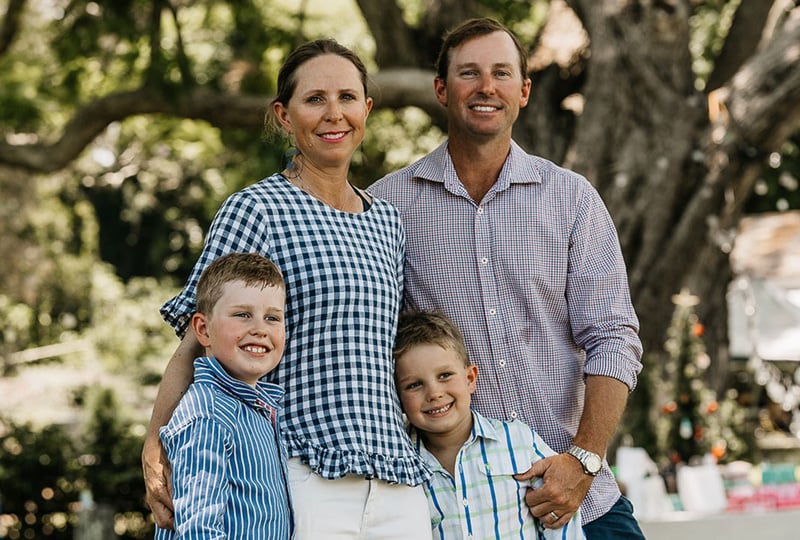
 Sasha and Will Treloar with their sons Campbell (left) and Zander (right).
Building drought resilience through smarter grazing management
On the sloping terrains of western Queensland’s Red Mulga country, fourth-generation producers Will and Sasha Treloar have spent the past decade building a more resilient grazing landscape capable of withstanding both flood and drought.
Based near Cooladdi, west of Charleville, the couple own and operate their 72,979ha organic beef enterprise.
They took over the reins from Will’s parents. Since his return to the property in 2012, with Sasha joining him in 2013, Will said they have focused on improving landscape functions, particularly in an environment where every rainfall event needs to count.
More recently, the pair became involved in the Lachlan Hughes Foundation (LHF) – a program offered to ten participants annually to build capabilities in:
- land management
- capacity building
- personal development
- landscape and project design
- regenerative agriculture.
Will said it was a move which has helped them grow both personally and professionally, giving them greater confidence to pursue new opportunities and continue exploring ways to improve their landscape.
Resting, rotation and really giving it a crack
Prior to their participation in LHF in 2023, Will and Sasha started their journey with the goal of better utilising annual rainfall events.
“We were repeatedly watching what we now know was 90% of our water run off the property after every rainfall event – which was really limiting our grazing country’s ability to sustain itself through dry periods,” Will said.
“2013 also marked the beginning of several years of drought for us, so seeing what little rain we did receive leave the landscape so quickly really motivated us to look for ways to keep more of that water in the system.”
Alongside lost water, the pair noted that there was likely also a loss of soil fertility. They made the call to attend an RCS Grazing for Profit course in Rockhampton as their first step to action.
“To improve our grazing land management strategy following the course, we slowly began reducing our paddock sizes and increasing water point access for cattle,” Will said.
“We then introduced a rotational grazing and paddock rest system to optimise our pasture availability and utilisation.
“We now have around 40 paddocks that we aim to rest for a minimum of two months – relying on visual cues to determine when we rotate.”
In addition to increasing ground cover, slowing water runoff and improving carrying capacity, Sasha said the rotational grazing strategy encouraged them to take a closer look at the relationship between pasture composition, soil health and overall landscape function.
As paddocks were afforded longer rest periods, the couple began noticing greater diversity in the species returning to the landscape. They questioned what those plants revealed about the condition of their country.
“Rather than seeing non-preferred species or weeds as a problem that needed to be immediately dealt with, we became more interested in understanding why they were there first,” Sasha said.
“What was that plant telling us about the health of our soils? Was it playing a role in preparing the landscape for the next stage of succession?”
“There’s a quote I love from the book The Power of Intention which reads, ‘if you change the way you look at things, the things you look at change.’
“It's probably reframed the way we respond to things and allowed us to step outside some of our traditional approaches and try new ideas, with the long-term health of the landscape always front of mind.”
Regenerating land and reviving curiosity
Invigorated by the insights gained through attending workshops and connecting industry experts, Will jumped at the chance to attend Tarwyn Park Training’s Natural Sequence Farming course with Stuart Andrews in 2022, when it was recommended by a fellow producer.
This is where he met Philip and Adele Hughes – parents of the late Lachlan, who founded LHF in his memory.
Will and Sasha began their involvement in the foundation in 2023. In 2024, they were successful recipients of the Lachlan Hughes annual scholarship, which linked them with regenerative agriculture professionals for training and mentoring.
Through a series of workshops, guest speakers and mentoring sessions, the program exposed participants to a broad range of topics spanning business management, leadership, communication and regenerative agriculture.
For Will and Sasha, one of the most valuable learning opportunities came through sessions focused on soil health, microbiology and plant succession.
“A lot of the learning helped us better understand what was happening below the surface,” Sasha said.
“There was a big focus on soil health, microbes and understanding how different plant species contribute to the broader function of the landscape.
“The sessions reinforced our growing belief that landscape recovery is a long-term process and that management interventions should work with natural systems rather than attempt to force rapid change.
“The country didn't get like this overnight and it won't return to what it was overnight either,” she said.
“Understanding succession and the role different plants play has helped us become more patient and more observant in how we manage the landscape.”
Personal growth
Beyond the technical learnings, the couple said some of the program's greatest impacts were personal.
“There was a lot of focus on personal growth and development – particularly in terms of building the confidence to step outside of your comfort zone,” Will said.
“On-farm, that translated to having the confidence to trial new ideas and trust the decisions we were making.
“We’d already started changing things, but the program reinforced that it was okay to think differently, keep learning and be open to trying new approaches if we thought they could improve our landscape.”
That confidence has also provided reassurance as the couple look towards the next inevitable dry period, giving them greater faith in the systems they have put in place to improve groundcover, water infiltration and landscape resilience.
Off-farm, Sasha said one of the most noticeable changes was Will's willingness to step outside his comfort zone and share their story with others, such as at the MLA beef industry breakfast as part of this year’s Northern Beef Research Update Conference.
“Those public speaking events alone have created so many more opportunities to connect with other producers and learn from their experiences,” Sasha said.
“Quite often people will come up and start conversations about the challenges they're facing on their own properties and how some of these ideas might work in their landscape.
“It reinforces that there’s no one-size-fits-all solution, but there’s a lot we can learn from each other.
“I think we can both agree that the key take home from this project is the need to be both curious and confident in not just yourself, but in your land, and in our industry.”