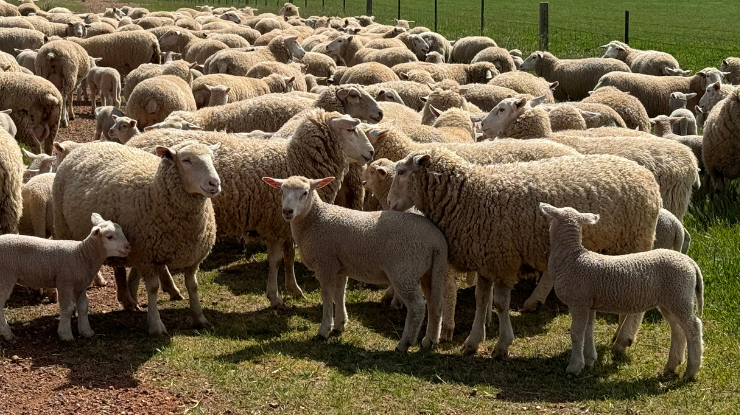
 Ewes and lambs at ‘Hills Park’, Yerong Creek, NSW
Setting ewe lambs up early for smoother seasons ahead
For NSW producer Andrew Hunter, ewe lambs were once the ‘poor relation’ in an otherwise high-performing sheep enterprise.
“We were pretty good at getting ewe lambs in lamb,” Andrew said.
“But we weren’t getting the results where it counts: lamb survival and how those ewes performed afterwards.”
Running a self-replacing maternal composite flock at ‘Hills Park’ near Yerong Creek, Andrew had long focused on turning off heavy lambs. However, that often meant his ewe lambs received less attention during critical growth phases.
Farm snapshot
-
Andrew & Jane Hunter‘Hills Park’, Yerong Creek, NSW
-
Area1,200ha
-
Enterprise4,000+ self-replacing maternal composite ewes
-
PasturesImproved pastures including lucerne and tropical grasses
-
SoilsRed-brown earths, lighter granite-based soils
-
Rainfall575mm
Proactive management
After joining the ‘More lambs from ewe lambs’ MLA Producer Demonstration Site (PDS), Andrew reassessed how ewe lambs were managed across the system.
The biggest change has been a shift from simply achieving conception to actively managing for survival and performance.
“We’ve put a lot more focus on getting ewe lambs up to a minimum joining weight and then keeping them growing right through to lambing,” he said.
Previously, lighter ewe lambs were still joined, relying on the flock’s natural fertility.
“We knew they’d get in lamb, but we weren’t managing them to actually perform,” Andrew said.
This shift reflects recent research, with the PDS demonstrating in practice that joining weight and continued growth are critical drivers of lamb survival and ewe performance.
Gains where it matters
While conception rates at Hills Park were already strong, the real gains have come at lambing.
“Where we’ve seen the difference is in survival, particularly in our twin mobs,” Andrew said.
Twin lamb survival has moved from just over 100% to now nudge 150%. In addition, Andrew has seen reduced ewe losses and hardly any prolapses.
Reducing pressure at lambing
Beyond the numbers, improved management has changed the on-farm experience during lambing.
Previously, lambing ewe lambs had become increasingly difficult.
“It was getting to the point where we were questioning whether we should even join ewe lambs – that’s probably been the real quantum shift,” Andrew said.
However, improved preparation has transformed that period.
“It just took a real weight off our shoulders knowing we’re doing the right thing.”
Learning through involvement
Over the years, Andrew has been involved in other MLA-led projects, working closely with advisors to test and refine management practices on-farm.
He said participating in the PDS has helped sharpen decision making and reinforce the fundamentals of ewe lamb management.
“We’ve always learned a lot from being involved, it’s been quite important to the management of our business,” he said.
Simple fundamentals, strong results
For Andrew, the biggest takeaway has been the importance of getting the basics right.
“It comes back to understanding what they need and managing them differently,” he said.
For ewe/lamb survival this includes:
- setting clear minimum joining weights
- maintaining growth through pregnancy
- prioritising ewe lambs within the feed system.
Setting ewe lambs up for life
A key insight from the project has been the long-term value of getting ewe lamb management right from the start.
“If they’re well grown for that first lambing, they’re much easier to manage afterwards,” Andrew said.
Well-prepared ewe lambs are now:
- easier to return to condition
- more consistent as a group
- better able to perform at their second joining.
“The aim is for them not to be a burden on the system,” he said.
“With the right management, they can perform much closer to mature ewes.”