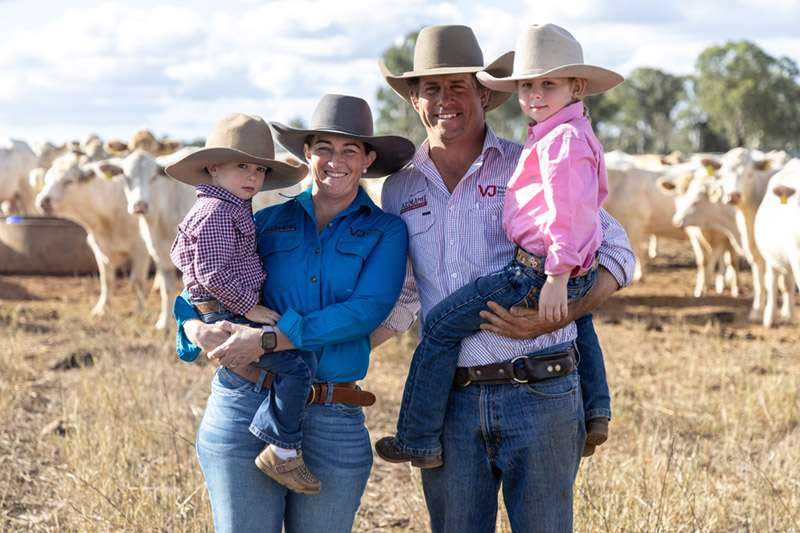
 Aleisha and James Pisaturo with their children Olivia and George, at ‘Inga Downs’. Image: Amie Hosking Photography
Could you be overlooking your best breeders?
In the Central Queensland Highlands, beef cattle producers Aleisha and James Pisaturo are leaning on herd performance data to back good stockmanship and reproductive decision-making.
With the use of genomic testing, Estimated Breeding Values (EBVs), and carcase feedback data, the Pisaturos are steadily improving the productivity, profitability and long-term performance of their stud operations and commercial herd.
The couple’s journey began 12 years ago, when Aleisha – supported by her family – purchased the 11,572ha property ‘Inga Downs’, Dingo.
Joined by James a year later, the pair grew their stud Charolais and Droughtmaster operations alongside a commercial breeding herd – producing cattle suited to northern production systems while targeting heavy feeder markets.
Farm snapshot
-
NameAleisha and James Pisaturo, ‘Inga Downs’
-
LocationDingo, Queensland
-
Area in hectares11,572ha
-
Enterprise1,400 breeders (250 stud Charolais, 100 stud Droughtmaster and 1,050 commercial Droughtmaster-Charolais cross)
-
PasturesBuffel, couch and native forest
-
SoilsBrigalow melonholes, with box running up into red tablelands
-
Rainfall675mm
A focus on fertility
According to James, fertility has been the number one driver behind every breeding decision made at Inga Downs, with a focus on targeting breeders that can recover and get back into calf quickly.
“Joining begins on 1 December each year, with stud females joined for approximately 12 weeks and commercial females up to 16 weeks,” James said.
“This allows for calving to then occur from September through to New Years – finishing in time for the wet season, which sets in around mid-January.
“Our breeders then make the most of the wet season pastures, with weaning taking place in June.”
As higher temperatures and tick pressures pick up during the later summer period, James said their reproductive cycle is also strategically planned out to have all calves on the ground before the new year kicks off.
“We run a tight schedule but it’s what we’ve found to be most successful in the environment we are working in – which ranges from the brigalow melonhole plains to the lancewood and rosewood tablelands.”
To target breeders that fit into their reproductive management program, James said they complete genomic testing on their stud program’s entire drop of progeny.
“We want to take the guesswork out of our decision-making and ensure we are optimising the best genetics,” he said.
"When you've got a number of good cattle that tick all the boxes structurally and phenotypically, genomic data helps identify which animals are going to deliver the greatest value.
“Combining that genomic data with recorded weights, muscle and fat scans, EBVs and any other noted physical traits also gives us a really clear picture of where our herd is at, and paints a picture of which genetics are meeting our target markets and performing best in our environment.”
For example, to target fertility they use fat and muscle scans – conducted by an accredited Performance Beef Breeders Association technician – to identify breeders with a bit more fat cover.
“This is a trait we learned to target when we noticed cows with a slightly higher fat ratio were more successful in getting into calf quickly and recovering better post weaning.”
Genomic testing delivers more than good genes
Having incorporated genomic testing into the production cycle for almost four years now, Aleisha said the benefits have brought more than improved fertility to their stud and commercial enterprise.
“We implemented genomic testing on our first drop of stud progeny in January 2023 – when it had just become available for Charolais cattle,” she said.
“While we were quite happy with how our cows were performing and felt confident in our ability to identify strong breeders from the knowledge and data we already had, we are still always looking for ways to improve our birth and weaning rates – even if the improvement we see in numbers is as little as 1%.”
Looking at their genomic data, Aleisha said it’s helped them identify a few genetic underdogs in their herd.
“Sometimes you’ll have a few calves – especially those born later in the drop – that don’t stand out from the mob in terms of size and average daily weight gain,” she said.
“They might be one’s you’ll usually overlook for breeding because of their weight or composition. However, when you pull up that genomic data, you’ll realise that they’re likely to be high reproductive performers.
“We have definitely had a few we’ve pulled to the front each year that we otherwise wouldn’t have, and while we aren’t seeing massive changes to our herd productivity, we are seeing a gradual improvement in our herd quality.”
Beyond the reproductive decision-making benefits, the Pisaturos said genomic testing has also made them better equipped to demonstrate the genetic potential of their sale bulls and provide buyers with greater confidence in their purchasing decisions.
“As seedstock producers, there's an expectation that our sale bulls are presented well phenotypically,” Aleisha said. “However, we don't want our clients’ making decisions on appearance alone.
“Genomic data paired with EBVs has been particularly valuable for clients – especially those looking to identify bulls with strong growth and carcase performance traits, while still maintaining the fertility and adaptability required to perform in northern production systems.
“It gives them confidence that the bull they’re selecting has the genetic capacity to perform in their operation, and helps us build stronger relationships based on transparency and trust.”
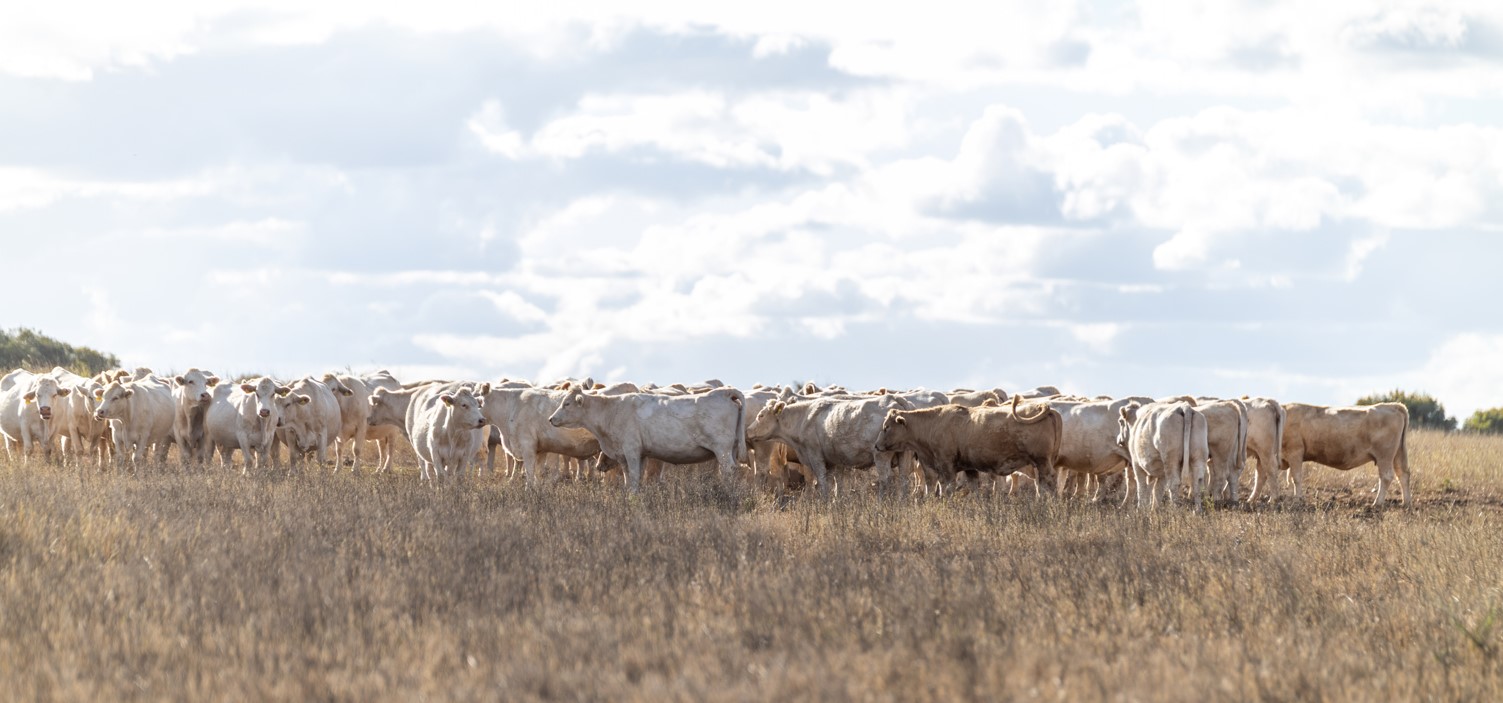
The Inga Downs herd includes stud Charolais and Droughtmaster cattle alongside a commercial Droughtmaster-Charolais crossbreeding operation. Image: Amie Hosking Photography
Carcase feedback shapes next generation
For the Pisaturos, understanding genetic potential is only part of the equation. They also want to know how those genetics perform in market.
At Inga Downs, surplus steers are marketed as heavy feeders into southern feedlot programs, while cull heifers from the stud herd are custom fed to capture valuable carcase feedback data.
An approach that provides the couple with a clearer picture of how their genetics perform beyond the farm gate and feeds directly into future breeding decisions.
“Carcase feedback helps us understand just how profitable our cattle are within our target market, and helps identify if there’s any on-farm issues we should be addressing – both in terms of genetics and stockmanship,” James said.
“This is something we really only started three years ago, but it’s been quite valuable in its ability to boost the accuracy and profitability of our decision-making.”
This carcase feedback delivers unique data that comes into play when they’re looking at the next generation of calves.
“Oftentimes, if we’re comparing two potential stud sires that are equally strong from a structural, phenotypic and genetic perspective, the carcase data can become the deciding factor,” James said.
“The bull backed by the strongest carcase performance data is often the one we’ll retain as a stud sire because we know he’s more likely to deliver value throughout the supply chain – not just on-farm.”
Data sits in the passenger seat
While genomic testing, EBVs and carcase feedback have become valuable tools within the business, Aleisha said data will never replace practical stockmanship and experience.
“We still spend a lot of time looking at cattle and assessing them visually before we ever get to the data,” she said.
“We almost see each bit of data as another piece of a puzzle we are building – helping confirm observations, identify opportunities and remove some of the uncertainty from breeding decisions.
“The puzzle pieces are all incredibly valuable, but it takes our knowledge and skillsets to put them together.”