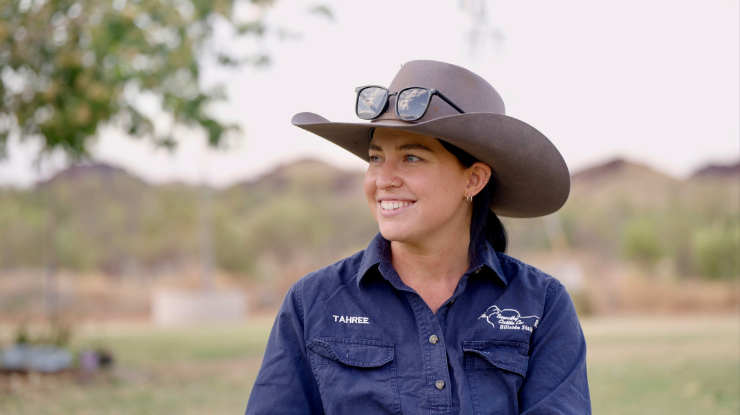
 Pilbara producer Tahree Kamman Image: Paul Bell – Feral Films
Good feed early makes better weaners
Real-time data has shed light on early growth patterns on a vast Pilbara, WA, cattle station.
Located east of Marble Bar, ‘Hillside Station’ spans 650,000 hectares of red sandy clay, loamy sands, spinifex, buffel grass and perennial river flats.
It’s a landscape known for extremes. With temperatures regularly reaching mid-40s and rainfall of about 300–350mm falling almost entirely during the wet season, timing and decision making are crucial.
Farm Snapshot
-
Tahree Kammann‘Hillside Station’, Marble Bar, Pilbara, WA
-
Area650,000ha
-
Enterprise20,000 Droughtmaster cattle, including 10,000 breeders
-
PasturesSpinifex, buffel grass, perennials
-
SoilsRed sandy clay, red loamy sands
-
Rainfall300–350mm
Weaning focus
Hillside is one holding within Brent Smoothy’s Smoothy Cattle Co enterprise. Its role is to allow weaners to move from the Pilbara to Queensland once they reach trucking weight. If they miss that window, they stay through the wet, adding pressure on pasture, increasing feed costs and raising labour needs. Hillside is one of the stations involved in producer-led research through the Pilbara Extension Network, facilitated by the Pilbara Innovation Partnership.
One of Hillside’s managerial team, Tahree Kammann, launched the project to explore how hay quality and mineral supplementation influence early growth rates to gain insight into rumen development and transition-to-paddock performance.
Seven mobs of weaners (290 head) joined the trial at 90–145kg (average 128–136kg). They were allocated to one of four treatment groups:
- Super grade Rhodes (high) with Multimin
- Super grade Rhodes without Multimin
- P2 Rhodes (low) with Multimin
- P2 Rhodes without Multimin.
All weaners received Ultravac 5in1 and Milne Early Weaner pellets.
After 7–10 days of yard weaning, mobs grazed in paddocks for 45–60 days, with liveweight recorded using Optiweigh units at induction, on 5 August and 23 August.
Animals sent to Queensland early were excluded from the data to ensure consistent comparisons.
Importance of feed quality
The most consistent finding across all mobs was that feed quality – not mineral status – drove sustained performance.
High quality Rhodes hay supported more reliable average daily gains (ADGs) both in yards and after weaners transitioned to paddock grazing.
In contrast, P2 Rhodes hay delivered decent gains during yard weaning but struggled to maintain momentum in paddock conditions.
This showed that early rumen development and feed digestibility were more influential than single-dose mineral supplementation.
Mineral supplements showed occasional short-term benefits but did not produce a strong or consistent effect across treatment groups. The evidence suggested that mineral availability was not the main limiting factor in this environment; feed quality and rumen maturity were.
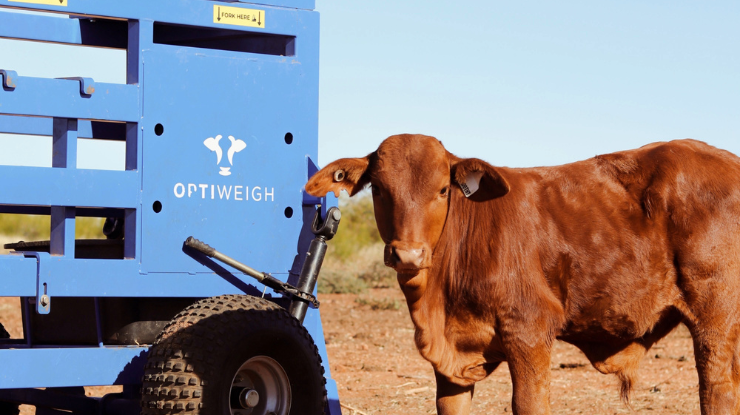
A weaner with an Optiweigh unit at ‘Hillside’. Image: Tahree Kammann
Ag-tech shapes decisions
Sapien data-management technology in the yards and Optiweigh real-time weighing in the paddock changed the way decisions were made at Hillside Station.
Instead of relying on visual estimates or post-muster weigh-ins, the Optiweigh units provided live insight into weight stability, gains or declines.
This enabled Tahree to identify which animals were ready to truck, which were stalling and when intervention might be needed. It helped prevent minor losses from turning into significant declines.
The data also revealed a clear behavioural difference between mature and less-mature weaners.
Heavier, more rumen-developed animals (130kg+) consistently achieved stronger, more reliable ADGs, especially on high quality hay without Multimin. Some of these animals recorded paddock gains of up to 1.52kg/day.
Conversely, lighter, less rumen-developed weaners showed more volatile weight trends. Some gained modestly, some stalled and others lost weight. This indicated that rumen maturity was a better predictor of long-term growth potential than starting weight.
Lessons learned
Tahree said one of the key operational lessons from the project was that maintaining strict consistency in treatment management was essential.
“Correct drafting, accurate pen allocation and ensuring uninterrupted access to hay, pellets and water made the data more meaningful,” she said.
“The importance of timing was reinforced – running a trial between mustering and trucking windows requires careful planning, adaptability and clear non-negotiables.”
Informing the future
While this trial wasn’t designed to generate financial return on investment data, its value lies in building knowledge to better inform decision making next season and scientific refinement in the seasons ahead.
It confirmed that not all weaners respond equally, identified that readiness is the key driver of performance and that hay quality drives sustained weight gain during the transition from yards to paddock.
Looking forward, Hillside’s managerial team plans to expand on this initial phase.
Priorities include tracking how hay treatment affects longer-term weaner performance once they arrive in Queensland, exploring ways to better support lighter weaners in rumen development and evaluating targeted supplements like B12.
The Optiweigh unit and data collection will continue to be utilised across the entire operation.
“My goal wasn’t to chase perfect results – it was to understand what drives performance here, in our environment, with our cattle,” Tahree said.
“Now we’ve got a starting point we can build on scientifically over the coming years.
“In 2026, we’ll continue trialling different weaning protocols, collecting data and exploring rumen development to lift ADGs, so we can keep making the best, evidence-based decisions for our weaners.”
This trial shows how producer curiosity, backed by real-time insights and practical tools, can lead to improvements in genetics, nutrition and management. Knowledge fosters better decisions – and at Hillside, those decisions are becoming clearer.
Producers leading change – Pilbara Innovation PartnershipAn 18-month pilot in the Pilbara, WA, is proving what’s possible when producers lead the way in research and development. The Pilbara Extension Network (PEN), delivered through the Pilbara Innovation Partnership (PIP), supports seven pastoral stations to design, deliver and evaluate projects that matter to their business. Each station nominates a project lead who shapes a project around a challenge specific to their operation, which can generate insights to benefit the northern beef industry in the long-term. Topics span grazing strategies, genetics, land rehabilitation, workforce development and data use. The collaboration between PIP, funding partners WA Department of Primary Industries and Regional Development, MLA, Rio Tinto, and producers ensures investment flows into locally identified priorities, aligning people, skills and leadership with improved landscape conditions and long-term productive capacity. Hillside Station is one of the businesses involved in the initiative. |