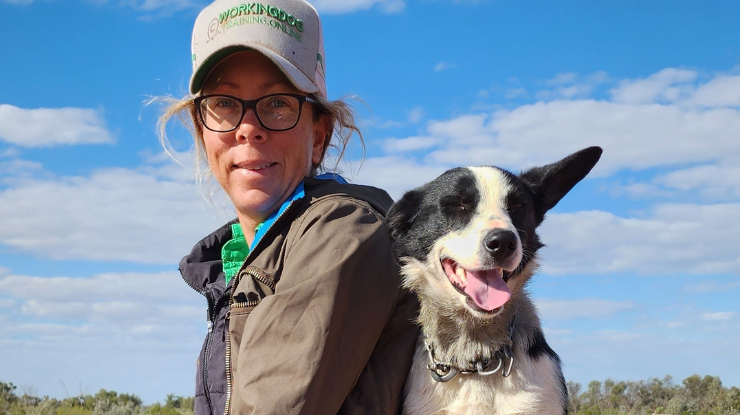
 Lauren Beresford and Millie at ‘Farnham Plains Station’, Eulo, Queensland.
Using cattle to restore claypans
Three key production challenges face 'Farnham Plains Station' in Queensland's mulga region: hard-setting clay soils, episodic rain and long feed gaps.
Lauren Beresford, fifth-generation grazier and a recipient of the 2024 Lachlan Hughes Foundation scholarship, used these challenges as the inspiration behind her claypan restoration project. The project later earned Lauren the Foundation’s 2024 Tree of Life Award.
After returning home to the family property five years ago, Lauren set about examining how she could use regenerative practices in her region’s semi-arid country, where clay soils have minimal topsoil, poor infiltration and shed water quickly.
She landed on a novel, cost-effective way to transform an area of previously unproductive claypan on her property by using her own cattle.
Farm Snapshot
-
Lauren Beresford‘Farnham Plains Station’, Eulo, Queensland
-
Area30,100ha
-
EnterpriseCrossbred beef cattle breeding enterprise with Santa Gertrudis, Angus and Brahman
-
PasturesNative pasture and mulga
-
SoilsSofter alluvial country types, gidgee, mixed mulga lands
-
Rainfall300mm
Regenerating the claypan
Lauren’s innovative approach saw her use the resources she had on-property to make an area of claypan adjacent to the main cattle yards and stables more productive.
“The area my project focused on had poor physical, chemical and biological soil health, with low microbial activity and low available nutrients,” Lauren said.
Importantly, her solution avoided the need to bring expensive inputs over long distances onto the property.
Instead, she decided to temporarily hold her weaners in a fenced-off area at the highest point of the claypan, so their manure, urine and hooves could nourish and break up its unproductive soils.
Some minor land contouring reduced run-off, allowing water to soak deeper into the soil – which after a period of rest began to spring back to life.
“I decided to yard the weaners overnight in an area of claypan near the house during our annual weaning – I fenced it off and gave them access to hay.
“During the day they were tailed out on good quality, diverse pastures.
“After nine nights they had trampled the soil surface and broken up the crust, as well as enriched the soil with dung and urine,” Lauren said.
Rest and recovery
After the weaners were moved on, Lauren left the area fenced-off to rest, and with the help of leftover hay that she had spread out, mulch started to form.
“I left the area of claypan to do its thing. Our reward has been new plant growth and insights into how we can make further areas of claypan on the property more productive,” Lauren said.
Lauren planted saltbush seedlings on the lower side of one-to-two feet high earth contour banks that she had formed using a grader. Despite the hard toffee rock beneath the shallow claypan preventing her from building them up any higher, they did a good job in stopping water run-off and increasing infiltration. The plantings helped stabilise the contour banks, caught dust and contributed to ground cover, which further improved water infiltration.
Some well-timed rainfall meant vegetation began to cover the freshly churned and nourished soil. While not yet ready to support increased carrying capacity, Lauren sees the long-term potential in regenerating further areas of land with minimal expense.
Resilient to floods
After severe floods in March 2025, the project area of revegetated claypan fared far better than other unrestored areas of claypan on the property, with a variety of pioneer and low succession plants, particularly winter annuals, emerging.
“The contouring and ground cover reduced erosion and the plants kept growing – it’s a way we can insure ourselves against future extreme weather events,” Lauren said.
Lauren hopes by demonstrating how producers can reinvigorate similar types of land easily and cost-effectively, greater productivity will be enjoyed in the region.
“I wanted the project to be simple and easily replicated by others,” she said.
|
Four steps to more fertile land
|
|
Stories like this sit within a broader global focus of women in agriculture, with 2026 recognised as the International Year of the Woman Farmer. |