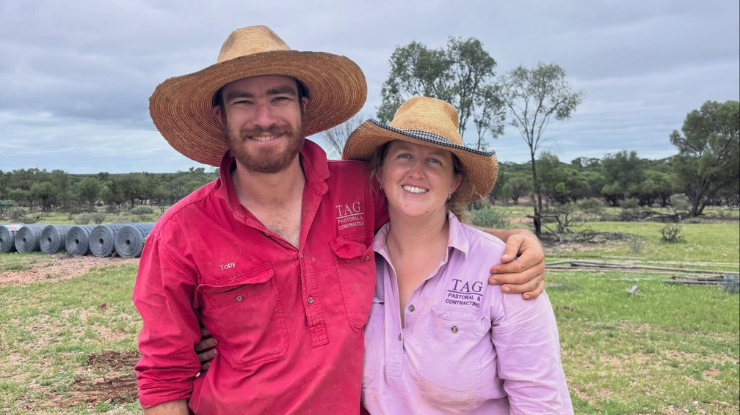
 Toby and Georgia Whip.
Building a better herd with data
When Central West Queensland goat producer, Georgia Whip, first moved with her husband Toby to his family cattle property south of Longreach in 2019, goats were little more than a means to manage timber encroachment – particularly the mulga and gidgee scrub creeping across the country.
However, Georgia found herself increasingly drawn to the goats.
It wasn’t long before she was actively managing what had previously been an unstructured, largely unmanaged herd. She introduced tagging, regular handling and drafting routines, and laid the groundwork for data-based decision making across the mob.
Her growing passion led her beyond the property boundary when she was encouraged by another woman in the goat industry to show her improved Rangeland goats at the Springsure Show.
There, she was introduced to a network of like-minded producers and University of Queensland (UQ) researcher Professor Louw Hoffman.
By the time Georgia and Toby purchased their own property just outside of Longreach in 2023 – a red-soiled, mulga-rich block she describes as “goat heaven” – she was ready to take the next step.
The same week they purchased the property, she phoned Louw and put her hand up to join MLA’s KIDS+ project, eager to contribute to and learn from the largest research initiative ever undertaken for Australia’s goat industry.
Farm Snapshot
-
Georgia and Toby Whip'Leander’, Longreach, Queensland
-
Area8,000ha
-
Enterprise4,500 rangeland nannies, bred with Boer billies, 30 Wagyu cows
-
PasturesGidgee and mulga scrub, and Mitchell grass
-
SoilsRed sands, pebbles and black soils
-
Rainfall450mm
Commitment to data
KIDS+ is a five-year MLA–UQ initiative designed to benchmark goat reproductive performance across Australian production systems, and demonstrate practical management changes that lift productivity, profitability and welfare.
KIDS+ captures data from more than 15 commercial properties located within Queensland and NSW. Georgia chose to enrol her entire nanny herd in the project, rather than a small mob like many of the other participating producers.
“I saw the project as my opportunity to establish key herd management and data collection strategies – under the guidance of experts – that would ultimately shape the future productivity and profitability of our herd,” she said.
The Whips run an average of 4,500–5,000 nannies. Throughout the project, they’ve made a point of capturing key metrics every time they came through the yards.
They captured data on:
- liveweight
- condition score
- sex
- estimated breeding value
- seasonal performance indicators tied to joining and weaning.
“We tracked them via individualised tags, and recorded both broad observations and consistent composition data that would help inform reproductive decision making,” Georgia said.
“Over time, we settled into a rhythm that aligned with our reproduction cycle – recording weights and condition scores of our nannies at the start of February before joining, and again at weaning in November.”
The Whips have also started tracking weaner weights for their does right up until their first joining, to build a comprehensive understanding of how they perform on their own, without their mum. This data helps identify potential issues early and informs future reproductive decisions.
Investment in time pays off
Investing the extra time to weigh animals came with an immediate additional benefit, as it provided Georgia with the opportunity to observe her goats more closely and record any visual defects.
“When you’re doing a manual draft – which is what we’d been doing before this project – you’re basing your future herd on split-second decisions,” she said.
“Now, while we’re collecting weights and we’ve got the goats in a crush, we’ve found ourselves able to get a really good look at their condition.
“We can look at their teeth, check their teats to see if any are missing or deformed, and see their conformation better – all factors that can impact productivity.
“When we record this information alongside key metric data, we’ve got a clear guide that ensures our decisions are confident ones."
Going ahead in leaps and bounds
Within three years, Georgia said KIDS+ has taken her herd productivity leaps and bounds beyond what she could have hoped.
“The project showed me not only how to collect the data, but how to interpret it,” she said.
“Before, all we knew were our overall herd numbers. Now, we can filter animals by age, weight range or performance history – it’s transformed our planning.
“I can look at the data and be able to determine with confidence an estimate of how many weaners I can sell and when.”
In addition to an improved reproduction performance, KIDS+ has also helped uncover insights on breed performance within Georgia’s environment.
One year, when they weaned earlier than usual due to the weather, they noted a difference in how the purebred and crossbred goats responded. They tracked weaner rates and, when they reviewed the data, found the crossbreeds performed better on average than the purebreds during that tougher climate period.
“We haven’t explored genetics much yet, but I would really love to look at targeting more drought-tolerant traits – using our data paired with genomic testing to further inform reproductive decisions and determine if a crossbreed herd may be better suited to our environment.”
Georgia also looked at her billy goats that were intended for market and, with the support of Louw, implemented a castration comparison trial to see if this would open up new markets.
Last weaning, they castrated approximately 200 males to see if there was a return on investing that extra time and resources.
The data showed a huge difference in average growth rates, with billies recording an average daily gain of 70-80g, whereas the wethers averaged 120g/day, with some gaining 200–270g/day.
“Unlike billies, wethers don’t look to mate, which means they focus purely on eating – allowing them to hit our target market weights of 35kg much quicker.”
KIDS+ part of the equation
Beyond productivity, the project has helped strengthen the Whips’ day-to-day operations.
The discipline of weighing, tagging and data collection encouraged Georgia and Toby to rethink how their property was set up.
This coincided with significant infrastructure investment in more than 60km of fencing, and a shift to rotational grazing. This has supported improved animal welfare, pasture utilisation and drought preparedness.
But for Georgia, one of the greatest benefits has been the partnership with researchers who respect and value producers’ lived experience.
“It’s been really great to work with the team from UQ and MLA, their ongoing collaboration ensures that insights are not only collected, but translated into meaningful, practical change,” she said.
“The project has ultimately left me with a greater sense of confidence, and an increased desire to continue taking those leaps of faith to try something new.”